This article contains affiliate links. Fondfolk may earn a commission if you buy through them. As an Amazon Associate I earn from qualifying purchases.
If the biscuits are browning before the centers are ready, give the oven a quiet trial before it has a pie, a casserole and dinner depending on it. Begin with its manual, the baking mode and the pan you used. Where the manufacturer supports a thermometer check, use equipment designed to measure oven air and observe repeated readings after preheating.
A single high reading is not enough to call an oven inaccurate. Heating cycles, thermometer position and opening the door all affect what you see. The useful result is a repeatable pattern you can compare with the appliance's instructions and the food coming out of it.
First, decide what seems wrong
Write down the problem in food terms. “The back row of cookies browned first” points to a different question from “every batch finished much sooner than expected.” A pale cake with a dark bottom deserves a look at the pan and rack position before you change the oven's settings.
Keep the recipe temperature, oven mode, rack position, pan material and actual baking time together in your notes. If you switched from a light metal pan to a dark one, or loaded two racks instead of one, include that. Changing several things between batches makes the result harder to interpret.
Our sheet-pan guide covers the pan itself. For a recipe written in grams, weigh the ingredients to keep quantities consistent during a comparison.
Find the instructions for your actual model
Look up the model number and read the sections on preheating, rack placement, temperature adjustment and uneven baking. Confirm whether the recipe calls for conventional baking or convection, and whether the oven automatically converts temperatures in a convection mode. Do not apply a second conversion without understanding the first.
Manufacturer advice differs. Whirlpool's product-help guidance warns against using a thermometer to determine oven temperature because cycling and instrument response can mislead. GE Appliances recommends a baking-performance check before treating an oven thermometer as the answer.
Follow the directions for your model when they specify a different test. A general thermometer procedure should not override them. If the instructions are unclear, the manufacturer's support team can tell you which check applies before you change a setting.
Use a thermometer made for the oven
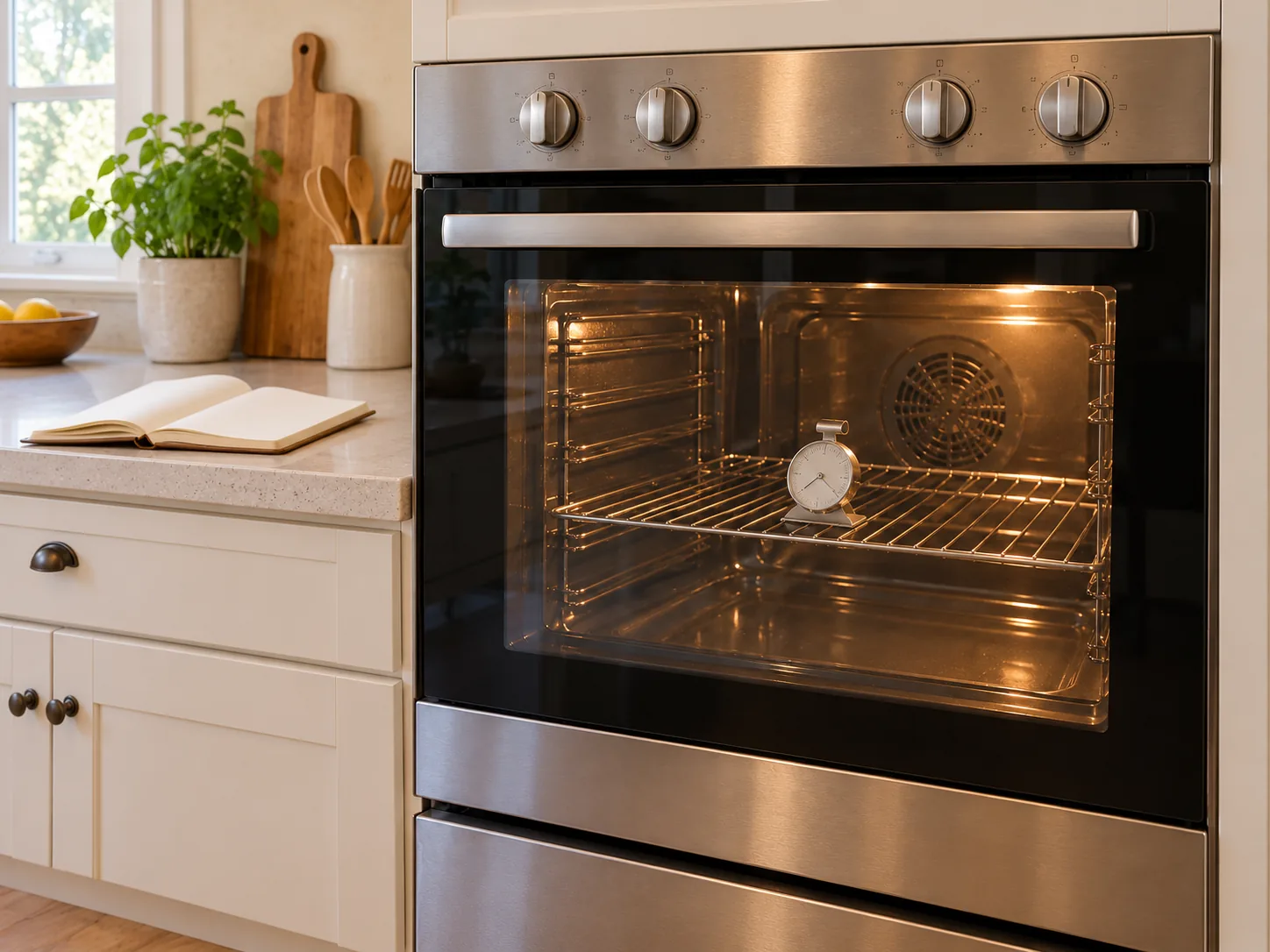
For an allowed temperature check, choose a dedicated oven thermometer rated for the temperatures you intend to observe. A suitable oven-rated air probe with a display outside the oven is another option. Follow both the oven's and thermometer's placement and temperature limits; keep any external display outside unless its instructions explicitly allow otherwise.
Do not leave a handheld instant-read meat thermometer in the oven. Its purpose is a brief food-temperature reading, and the probe's measuring range does not make the whole device oven-safe.
An infrared thermometer answers a different question, too: it measures the surface it sees. Pointing one into the oven does not measure the air around a cake. ThermoWorks explains that distinction in its thermometer guidance.
Read the instrument's stated accuracy and scale before interpreting a small difference. A dial with broad markings cannot establish a precise one-degree error, however carefully you stare through the glass.
Observe a heating pattern, not the preheat beep
Use this approach only where the model instructions allow an independent thermometer check. It is a way to collect useful observations, not a substitute for the manufacturer's calibration procedure.
- Set up while the oven is cool. Use the rack position and instrument location specified for the check. A central position is a common starting point, but the sensing part must measure air rather than rest against a pan, wall or heating element. Secure the thermometer as its maker directs.
- Choose one mode and setting. Use the manufacturer's test temperature. If its instructions permit a general check without naming a setting, 350°F in conventional bake is a useful reference used in Whirlpool's general calibration article. Record the setting and units before starting.
- Allow the specified preheating and settling period. The first arrival at the set temperature is not a complete picture of the next heating cycles. Do not mix those early readings into a later comparison without noting them.
- Record a sequence with the door closed. Read through the window or use an appropriate external display. Follow the instrument's observation or averaging instructions and allow several heating cycles. Keep the same position and setting throughout; note any door opening or interruption.
- Repeat the same check before drawing a conclusion. Start from comparable conditions on another run. If the results disagree, resolve the setup or instrument question before deciding how much the oven is off.
With a simple dial, take observations at regular intervals across the check rather than writing down only its highest point. A slow-moving dial may not show every rise and fall. Equipment that logs readings or calculates a running average can supply a fuller record, but it still needs correct placement and a method appropriate to the oven.
Read the notes carefully
Ovens normally heat above and below their set point as the heat switches on and off. The size and timing of that movement vary by model; there is no one allowable swing that applies to every oven.
Use a small record like this:
| Record | What to write |
|---|---|
| Setup | Oven model, mode, setting, rack and thermometer position |
| Timing | Preheat signal, any settling period and observation times |
| Readings | The sequence or instrument's logged record |
| Interruptions | Door openings, moved equipment or changed settings |
| Baking result | Recipe, pan, placement, time and browning pattern |
Do not treat the midpoint of the highest and lowest readings as an exact average. Those two numbers do not tell you how long the oven spent at either temperature. A handful of observations also cannot establish a calibration offset to the nearest degree.
ThermoWorks' oven-check guidance demonstrates why readings across time matter. Use the record to identify a persistent concern, then compare it with the method and tolerances given by your appliance manufacturer.
Give the oven a normal baking job
If the manufacturer recommends a packaged-biscuit test, follow that test and the package directions, including the pan and rack. Do not turn a biscuit's shade of brown into a numerical temperature reading. The test tells you about baking performance under those conditions.
For your own familiar recipe, keep the pan, portion sizes and rack arrangement the same when repeating it. Follow the recipe's doneness cues, not the clock alone. If you need to rotate a tray according to the recipe or oven instructions, record when you did it.
Leave the circulation space the manual calls for around pans, and do not cover the oven floor or an entire rack with foil. A crowded holiday load can behave differently from one small trial batch. Assign each dish its pan, oven mode and cooking time before the day.
Adjust only when the evidence and manual agree
A documented, repeatable temperature mismatch may call for the model's permitted temperature adjustment. Follow its exact process and then repeat the appropriate check. Do not copy a button sequence from a different model or automatically subtract a fixed number from every recipe.
If heating is erratic, the door does not close correctly or ordinary troubleshooting does not resolve the problem, arrange service. Calibration is not a repair for damaged parts.
Keep the manual and your notes together once the check is finished. For the holiday bake, you then have a known rack position, the right mode and an observed cooking result to work from—before the pastry is rolled out.
Keep one test from becoming several tests
Use the same permitted thermometer position, oven mode and observation procedure for a repeat check. Opening the door often, changing shelves or switching between convection and conventional baking introduces new variables. Record those changes if they happen rather than comparing the numbers as though nothing changed.
The aim is to give yourself or a service technician a usable description. Write down the model, setting, preheat procedure and repeated readings alongside the food problem. A photograph of one dial at one instant rarely explains a heating cycle.
Choose a manageable bake while the question is open
If the oven behaves unpredictably, avoid making the first investigation the most important cake of the holiday. Choose a familiar recipe and follow its specified pan, rack and doneness checks. Keep the menu small enough that you can observe the bake without also managing three other hot dishes.
Do not compensate by changing the recipe’s temperature, pan depth and baking mode all at once. You would then have several possible explanations for the next result. If the appliance needs service or cannot operate safely, use suitable alternative equipment or change the menu. A written timeline cannot make an unreliable oven reliable.