This article contains affiliate links. Fondfolk may earn a commission from qualifying purchases. As an Amazon Associate I earn from qualifying purchases.
The sharp pop from a sheet pan in the oven usually comes from the metal changing shape as it heats. Different parts expand at different rates, and the broad base can flex or buckle. Some pans settle back as they cool; others keep the twist. Let the pan cool before judging it, then look at whether it sits steadily and still holds food where you put it.
Replacing it makes sense when its shape or condition interferes with safe, practical use. If you do need another pan, choose for your oven, your recipes and the care you will give it. A heavier tray is not much help if you cannot comfortably lift it with dinner on top.
Why the metal moves
Heat causes metal to expand. Uneven heating and sudden temperature changes can make different areas of a baking sheet move unequally. Nordic Ware’s explanation of warping identifies heat stress, rapid cooling and uneven loading as contributing factors. Thin pans can be particularly susceptible to flexing.
A temporary change under heat and a persistent bend are different observations. The sound alone does not tell you how badly a pan is damaged or whether its coating is intact. Nor does silence prove the pan is flat. Oil collecting in one corner or a cooled tray rocking on a level counter is more useful information about its current shape.
I would not interrupt cooking to try to bend a hot pan straight. If food or hot fat is at risk of spilling, stop and handle the situation carefully with suitable oven protection. Assess the pan once it is cool; forcing it back by hand is not a universal repair method for different metals, rims and coatings.
Decide whether the existing pan still works
Place the clean, cool pan on a known level surface and inspect the base, rim and cooking surface. The decision should follow what you find:
| What you notice | Practical next step |
|---|---|
| It lies flat again, its surface is intact and it remains stable on the oven rack | Follow its manufacturer’s use limits and watch whether the problem recurs. A previous pop alone does not establish that replacement is necessary. |
| A bend makes food or oil collect at one end | Set it aside from cooking until the manufacturer advises whether that model can be safely used or repaired. |
| It rocks badly, twists when lifted or has damaged edges | Replace it or pursue the manufacturer’s repair/warranty route. Do not rely on a liner to fix its structure. |
| The surface is peeling, flaking, deeply damaged or corroded | Stop using it for food and follow the manufacturer’s replacement guidance. |
Staining is a separate question. Some discoloration on a particular uncoated pan may be cosmetic; that does not mean all marks on every coated pan are harmless. Identify the material and use its care guidance before reaching for an abrasive cleaner.
A photograph of the cooled pan and its product details can help the manufacturer assess a recurring problem. Include the temperature and cooking mode you used. A broiler, a stovetop burner and a conventional oven are different conditions, even if the same pan physically fits under or over each one.
Measure the outside and the cooking area
Two dimensions matter when choosing a replacement: the outside footprint that must fit the oven, and the usable surface that must fit the food. Rims and handles can make those measurements substantially different.
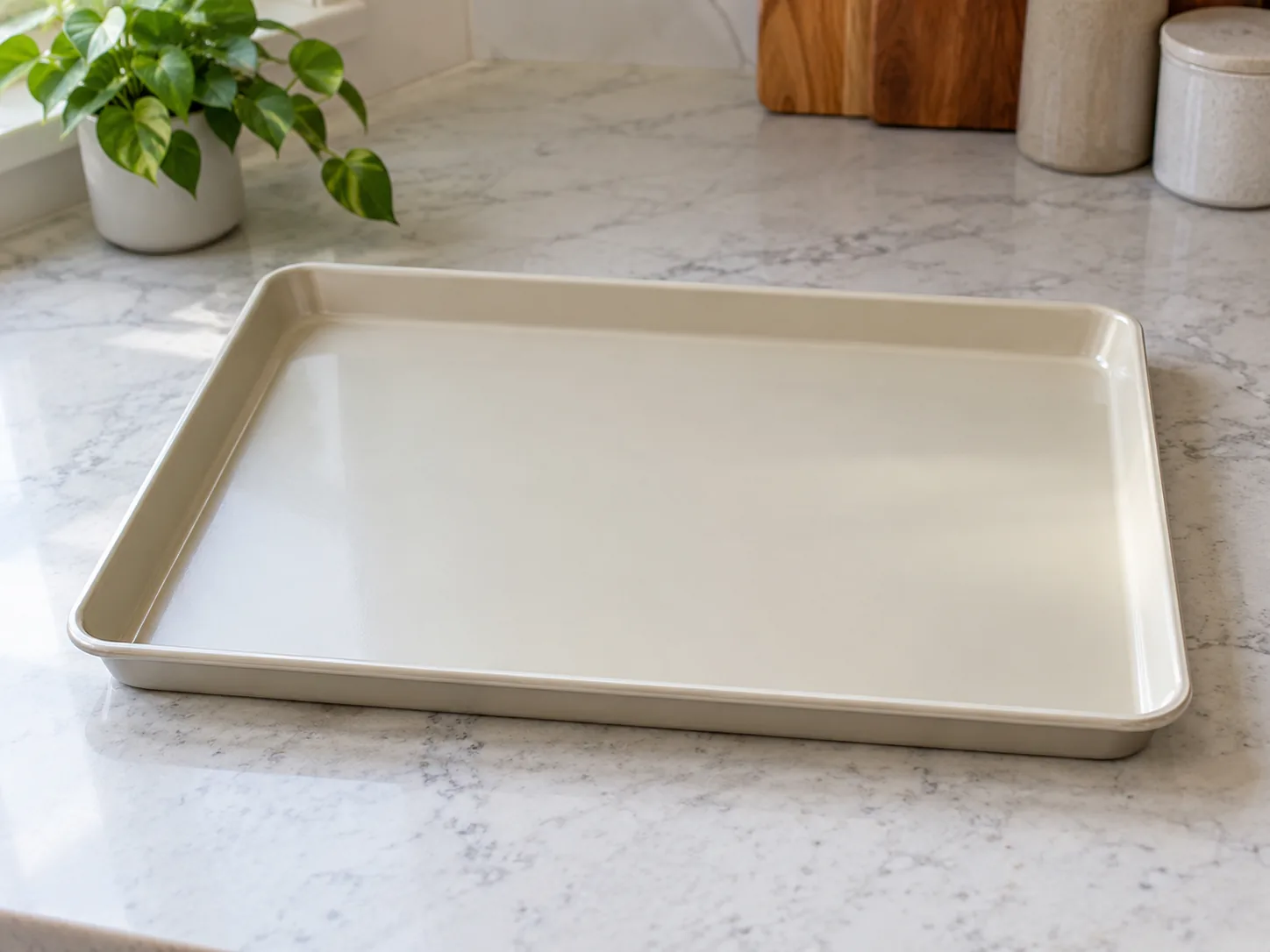
I recommend the Caraway 15-by-10-inch ceramic-coated baking sheet when that medium size fits the batch. It has an aluminized-steel core with a ceramic coating, so it is still a metal baking sheet. Its listed size is not a measurement of the flat area available between the rims; compare the usable surface and outside footprint before buying.
For comparison, Nordic Ware’s half-sheet dimensional drawing lists an outside footprint of 17.9 by 12.9 inches and an inside area of 17.1 by 12.1 inches. A recipe spread across that larger sheet may need two medium sheets or consecutive batches. The name on the pan does not provide both measurements.
Measure your oven shelf and follow the oven manual’s required clearance around cookware. Leave room to grip and remove the pan with oven mitts. If you plan to use two pans together, measure that arrangement too; separate fit checks do not prove they will fit side by side.
A smaller pan may be easier to lift, wash and store, but it gives the food less room. Do not squeeze a recipe onto it and assume the same result. For roasted vegetables, use an appropriate batch size and cooking arrangement; our guide to vegetables that steam instead of brown explains the crowding problem.
Also try the size against your sink and storage space. A broad pan you can rinse and dry easily may be more useful than the largest one the oven will admit.
Look at the base and rim together
Metal thickness contributes to rigidity, but construction is more than thickness alone. A reinforced rim can help the sheet keep its shape. USA Pan describes steel-wire reinforcement in most of its rims, while other makers use their own rim and metal combinations.
Look for a clearly identified base material and construction rather than treating “heavy duty” as a complete specification. A weight figure can help compare similar-size pans, although it does not tell you how comfortable a loaded pan will be in your hands.
I prefer a rimmed sheet for vegetables and foods that release liquid. Choose enough usable area for the recipe and a rim you can grip securely. A flat cookie sheet and a rimmed roasting sheet do not handle the same jobs equally well; neither one replaces a deep baking dish for a casserole.
For a holiday menu, assign the actual pan before scheduling the oven.
Match the surface and heat limit to the recipe
Uncoated metal, silicone-coated bakeware and ceramic-coated bakeware have different care requirements. Read both the base material and the coating information. A description such as “ceramic” may refer to a coating over metal rather than a pan made entirely of ceramic.
When choosing cookware sold as non-toxic, I prefer explicit materials information and clear use limits. A broad label does not establish which surface the pan has, whether it tolerates a broiler or how to care for damage. Look for the manufacturer’s statement about the particular model, not a claim applied to every pan in a category.
Temperature limits vary. Caraway rates this baking sheet for oven use up to 550°F, but its care directions exclude the broiler, stovetop and microwave. Preheat the oven first and load the food onto the sheet before it goes in; do not preheat the sheet empty. The oven rating does not make every kind of high heat suitable.
Caraway describes this coating as made without PFAS, PTFE and PFOA. That specific materials statement is more useful to me when choosing cookware sold as non-toxic than treating the label as a guarantee under every cooking condition. Follow the temperature and care instructions along with the materials information.
Any liner or rack used with the pan also needs to suit the cooking conditions. Parchment and silicone mats do not straighten a bent base or increase the pan’s temperature rating. Follow the most restrictive relevant limit in the equipment instructions and recipe.
Help the replacement keep its shape
Let the pan cool before washing it, and avoid moving it straight from the oven into cold water. Follow the maker’s instructions for preheating, refrigerated food and washing. Do not leave perishable food sitting out just to warm a chilled pan.
Use the cleaning method specified for the surface. For the Caraway sheet, use liquid oil or butter instead of aerosol cooking spray, choose wood or silicone utensils and hand wash once it has cooled. Caraway’s care instructions give the surface-specific details. Avoid metal scrapers and abrasive cleaning. Other pans have their own requirements; one tray’s cleaning routine is not a reason to scrub every tray the same way.
Save the product instructions where you can find them. The next time you roast carrots or bake biscuits, the useful details are the pan’s size, surface, heat limit and care—not whether it still looks new.
Try the empty-oven fit before a busy meal
Use the cool pan to check the oven’s usable shelf space before it is loaded with food. Include the rim and handles in the footprint and leave the clearances required by the appliance. A tray that can be forced onto a rack is not necessarily one you can remove level while wearing oven gloves. Check that the door closes without pushing it.
Then picture the food load. A shallow sheet with a wide rim may fit the oven but offer less usable area than expected. For a recipe that needs space around vegetable pieces, that difference can determine whether you need a second cooking round. Buying a larger nominal size without measuring does not resolve the capacity question.
Keep a short pan-use record
If a tray makes a popping sound, note what was on it and how it was heated and cooled. A half-covered sheet, an abrupt move into cold water and a pan used beyond its maker’s limit are different situations. The note does not diagnose the metal, but it helps you ask the manufacturer a specific question.
Do not try to straighten a hot tray by pressing it against the counter or loading it with heavy objects. Let it cool, then assess its stability and condition as described above. If it cannot sit securely or its cooking surface is damaged, plan dinner around suitable equipment you already have while choosing a replacement. The shopping decision can wait; a stable hot-food surface cannot.