Three ingredients and the right sheet
Estimated timing: 15 minutes preparation, 20 minutes chilling, up to 20 minutes baking and 10 minutes cooling. This estimate starts with thawed pastry; if frozen, thaw according to its package before starting.
- 250 g puff pastry sheet, thawed, about 30 × 24 cm
- 50 g granulated sugar
- 1 tsp ground cinnamon
We may earn a commission from purchases through these links. Amazon search links open comparison results; check the selected item’s suitability.
Measure the sugar with a kitchen scale so the coating stays proportional to the sheet. The recipe is written for one rectangle, not every sheet in a multi-sheet pack. A larger or heavier sheet changes the slice size and yield.
Fold, chill and bake
- Mix the 50 g sugar with 1 tsp cinnamon. Scatter half over a clean work surface and lay the thawed 30 × 24 cm pastry sheet on it. Scatter the other half over the top. Roll lightly just to press the sugar in, keeping the rectangle close to its original size.
- With the 30 cm edges at the top and bottom, fold each of those long edges halfway toward the center line, then fold each again to meet at the center. Fold one half over the other like closing a book. The log is about 30 cm long. Cover and refrigerate for 20 minutes.
- Heat the oven to 200°C / 390°F conventional. Line two baking sheets with parchment rated for this temperature. Cut the chilled log crosswise into 20 slices, each about 1.5 cm thick. Lay the cut faces flat with at least 5 cm between slices. Bake for 16–20 minutes, turning the palmiers over halfway through, until both faces are golden. If using two shelves, exchange the tray positions when turning. Check early if your pastry is thinner.
- Let the palmiers settle on their trays for 5 minutes, then move to a wire rack for another 5 minutes. Serve once cool enough to handle.
We may earn a commission from purchases through these links. Amazon search links open comparison results; check the selected item’s suitability.
Use a rolling pin lightly to press the sugar into both surfaces. Do not stretch the pastry into a much larger sheet: thin dough can lose the definition of the two curls. Keep any suitable pin you already own.
Leave room on each baking sheet for the spirals to open as they bake. Divide the 20 slices between two trays and use heat-rated parchment. Use trays that fit your oven with clearance for airflow; if baking in batches, keep the second batch chilled until its turn.
Help the double spiral hold its shape
The two folded sides should meet at the center before you close the log. Cut straight down with a sharp knife instead of sawing repeatedly and dragging the layers. If the log softens while you work, return it to the refrigerator until firm enough to cut.
Watch the color as well as the clock. Sugar can darken quickly toward the end, while a pale underside can still feel soft. Turn the palmiers halfway through and remove them when both faces are golden.
After the first 5-minute tray rest, a cooling rack lets air reach the undersides. Moving them too soon can distort the curls; leaving them on a hot tray throughout cooling keeps the bottoms warmer for longer.
Serve on a Christmas cookie plate
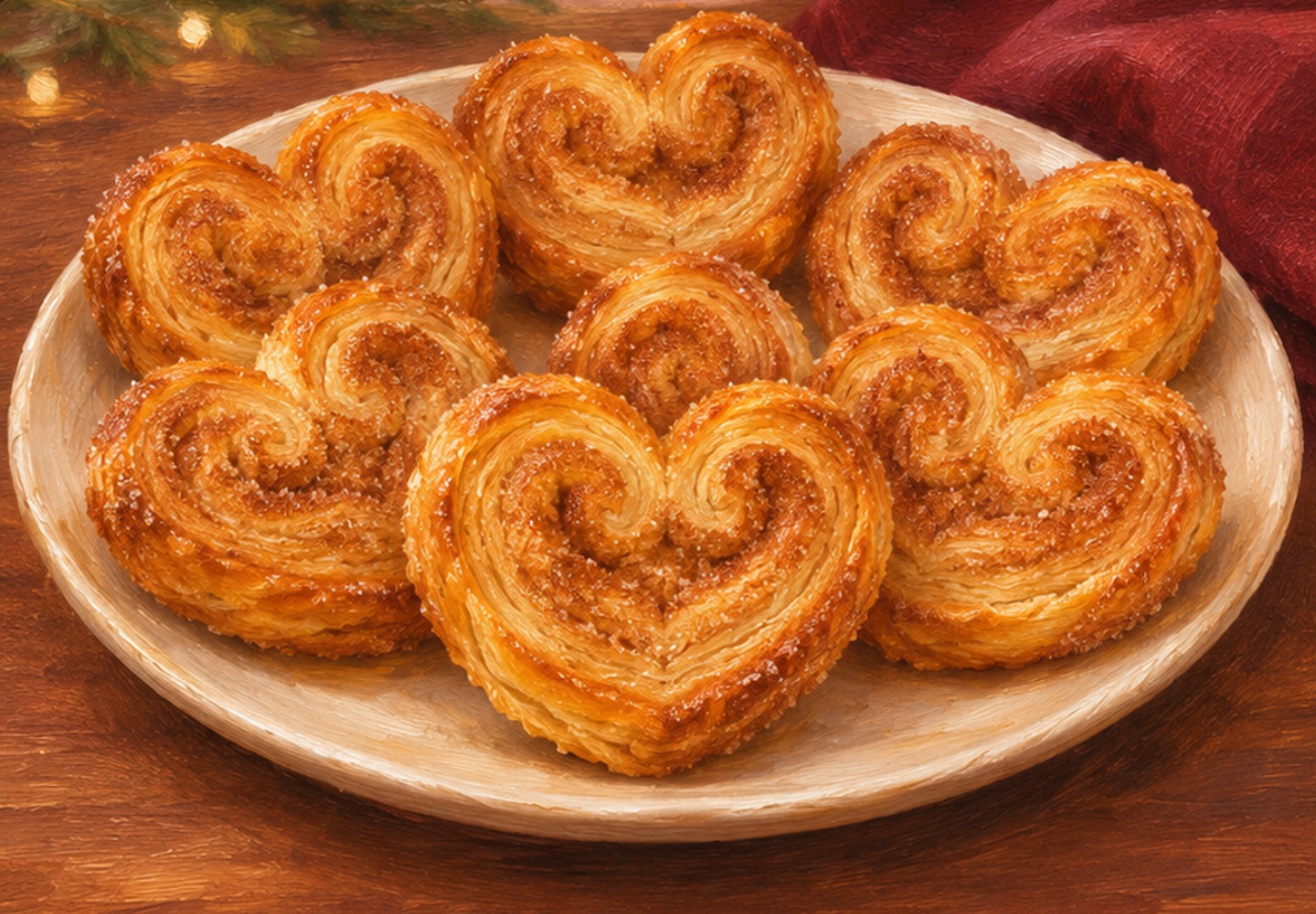
The recipe makes 20 palmiers; the illustration shows a serving portion. Serve the day they are baked for their crispest texture. Let them cool completely before putting them in an airtight container, and keep them away from steam or soft frosted cookies. No icing or extra decoration is part of this recipe.
Puff pastry contains wheat and may contain milk or other allergens; check its label. Timing is estimated and depends on pastry thickness and oven behavior. This is Fondfolk’s cinnamon-sugar variation; the image illustrates the finished style.
For another festive bake, see cranberry-orange shortbread.