Halloween party games do not all need a large room, loud music or a complicated relay. These three tabletop activities give guests something easy to begin while food is being served, costumes are being adjusted or another game is being prepared. The materials are simple, the rules fit in one sentence and every game can be made before the party starts.
Set the three games on separate corners of one table so pieces and markers stay with the right activity. A small tray beneath each game makes it easier to move everything when the table is needed for food. Keep a finished example beside the drawing game, but leave enough space for guests to make their own choices.
1. Pumpkin and Ghost Tic-Tac-Toe
Makes: 1 reusable game
Supplies
- 1 warm-cream cardstock square, 12 × 12 inches
- 4 narrow dark-olive tape strips
- 5 orange cardstock pumpkin pieces
- 5 warm-cream cardstock ghost pieces
- 1 black washable marker
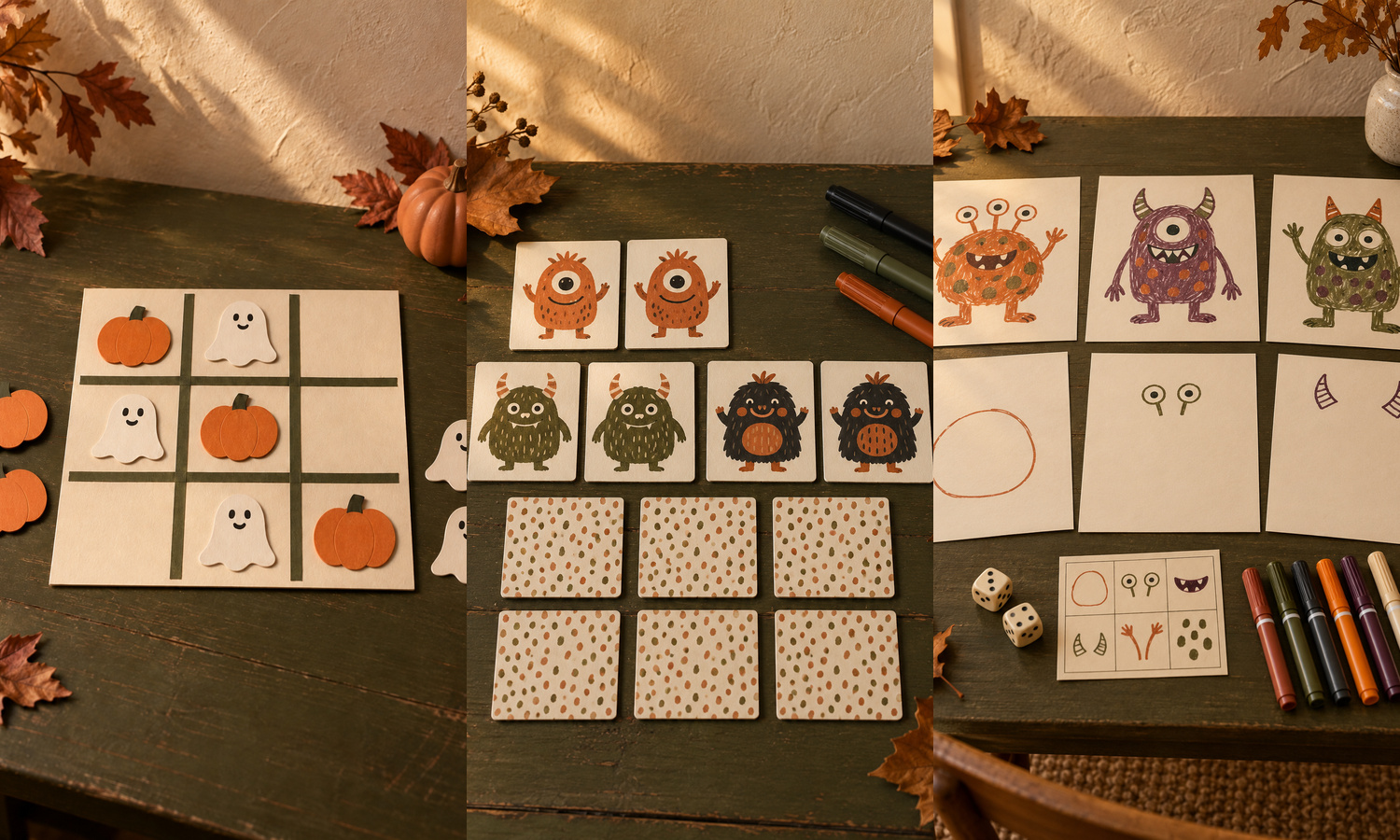
Lay two tape strips vertically and two horizontally to divide the square into nine even spaces. Press every tape end flat against the board so pieces cannot catch on a loose edge. If the tape is wider than needed, cut it lengthwise before placing it on the cardstock.
Cut five simple pumpkin shapes from orange cardstock and five rounded ghost shapes from cream cardstock. Add stems and friendly faces with the black marker. Keep the pieces broad enough to cover with two fingers; very small pieces are harder to move and easier to lose.
Brief instruction: Tape a 3 × 3 grid; take turns placing pieces until someone gets three in a row.
One player uses pumpkins and the other uses ghosts. Players alternate placing one piece in an empty square. The first person to make a horizontal, vertical or diagonal row of three matching pieces wins. If every square is filled without a row, clear the board and play again.
Store all ten pieces in a small envelope with the board. To keep games moving at a party, put a simple “winner stays for one more round” limit in place, then invite the waiting guest to take a turn.
2. Monster Match Cards
Makes: 6 matching pairs
Supplies
- 12 small warm-cream index cards
- Washable markers in three colors
- 1 black washable marker
- 1 small storage envelope
Divide the cards into six pairs before drawing. Give each pair one clear feature that can be recognized quickly: one eye, striped horns, three teeth, round ears, long arms or large spots. Draw the same monster twice, then move to the next pair. The drawings do not need to be perfect copies; the defining feature and colors only need to match.
Keep the backs of all 12 cards plain and identical. If ink shows through the cardstock, glue each card to a second blank layer or use heavier paper. Let every drawing dry before stacking the cards so the marker does not transfer.
Brief instruction: Draw six matching pairs; shuffle face down and take turns finding matches.
Shuffle the cards and arrange them face down in three rows of four. Each player turns over two cards. A matching pair stays with that player; two different cards return face down in the same positions. Continue until all six pairs have been collected. The player with the most pairs wins.
For younger guests, begin with four pairs and add the final two when everyone understands the game. For older players, allow only a few seconds to study each revealed card before turning it back over. Put the complete deck in its envelope after play so it is ready for another round.
3. Roll-a-Monster Drawing Game
Makes: a game for 6 players
Supplies
- 6 sheets warm-cream drawing paper
- 6 washable markers
- 2 ordinary dice
- 1 six-box feature guide
Create one shared guide with six boxes. Assign one feature to each die result: one for the body, two for eyes, three for a mouth, four for horns, five for arms and six for spots. Use simple pictures instead of long written directions so the guide can be understood at a glance.
Give each player one sheet and one marker. Put the guide and dice in the center. Players can roll one die at a time or use both dice and add two features during each turn. A repeated result means adding another version of that feature, so a monster might end up with several eyes, extra arms or two different mouths.
Brief instruction: Roll six times; add the feature shown for each result to build a monster.
After six rolls, let players add color or a final detail without rolling. There is no winner unless the group wants to invent lighthearted categories such as tallest horns, most eyes or friendliest monster. Avoid ranking the drawings as best or worst; the unpredictable combinations are the point of the game.
Keep both dice on a shallow tray so they do not roll onto the floor. If the table is shared with snacks, move the drawing papers and markers to a separate clean section and keep the dice away from serving dishes.
Set Up One Calm Game Table
Put the tic-tac-toe board at one end, the matching cards in the middle and the drawing game at the opposite end. The first two activities work for two or more players, while the drawing game can include all six prepared places. Leave one chair-width of space around each side so guests are not reaching over one another.
Check every handmade piece before the party. Trim rough cardstock corners, press loose tape flat and replace any cracked dice or uncapped marker. Small paper pieces and dice are not suitable for children who may put them in their mouths, so match the games to the age of the guests and supervise as needed.
When the party ends, count the ten tic-tac-toe pieces, pair the 12 matching cards and return the dice and markers to their tray. The games store flat in one large envelope or shallow box and can return next Halloween without rebuilding the whole table.
Together, the three activities offer different kinds of play: quick strategy, visual memory and open-ended drawing. Guests can join for one round without interrupting the rest of the party, and the warm cream, dark olive and terracotta materials keep the table consistent with the rest of Fondfolk’s Halloween collection.