An apple for a crisp has a different job from an apple for sauce. In a crisp, you want tender pieces under the topping. For sauce, you can let the fruit lose its shape. Start with what you are making, then choose a variety suited to that result.
This article contains affiliate links. Fondfolk may earn a commission if you buy through them. As an Amazon Associate I earn from qualifying purchases.
For baking, choose apples that keep some shape
Granny Smith, Honeycrisp and Pink Lady are useful starting points for pies and crisps. Iowa State Extension identifies Granny Smith as a baking apple and notes that Honeycrisp and Pink Lady retain their shape when cooked. Granny Smith also brings tartness, which is useful when the dish already includes a sweet topping.
A variety name alone does not guarantee identical results. Follow the recipe's cut size and check tenderness as well as the clock. Large chunks and thin slices are different preparations, even when they come from the same bag.
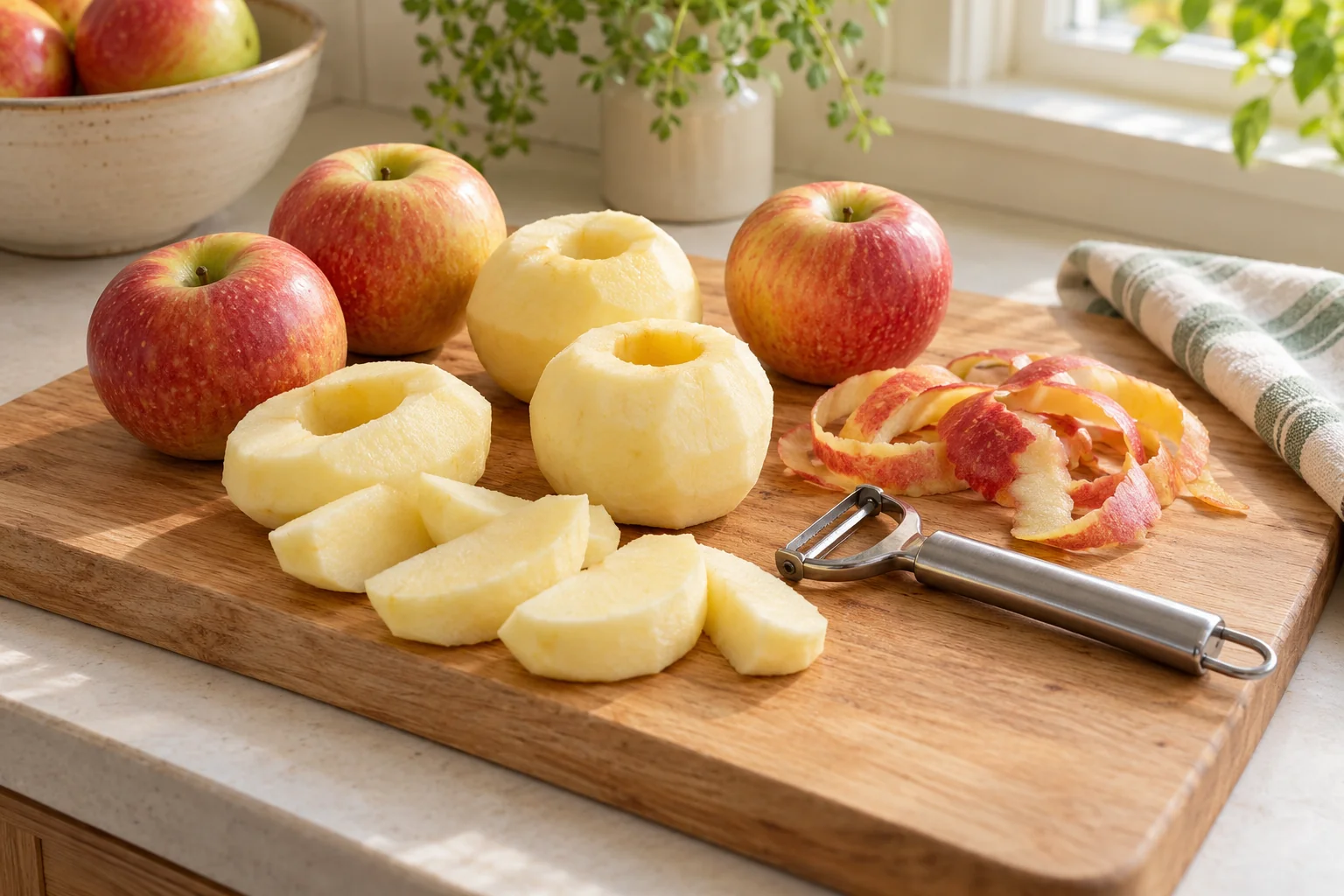
For apple crisp with orange and cinnamon, weigh the apples after peeling and coring: the recipe calls for 1,200 grams of prepared fruit. I recommend the KitchenAid dual-platform scale for weighing the prepared apples. Cut the pieces into 1-inch chunks no more than 1/2 inch thick. Keep the specified deep 9-by-13-inch baking dish; a shallow sheet pan is a different piece of equipment.
For sauce, you have more choices
The University of Illinois Extension apple chart lists McIntosh, Gala and Golden Delicious among the apples suited to sauce. It also lists Granny Smith, Honeycrisp and Pink Lady, so the baking and sauce groups overlap.
Choose a sauce recipe before deciding how much fruit to buy. A recipe intended for immediate eating is a different project from a tested canning recipe, whose ingredient proportions and processing instructions need to stay intact. This shopping guide is not a canning method.
For a first batch, use one named variety and record whether you would want the finished sauce sweeter or more tart. That gives you something specific to change next time, rather than an unlabeled mixture you cannot repeat.
For snacking, let your own tasting decide
Buy a few loose apples and try them plain. A variety chart can suggest a baking use, but it cannot choose your favorite bite. The apple-tasting scorecard gives sweetness, tartness and texture their own spaces, so a crisp apple does not automatically become the sweetest one on the page.
Keep the names with the fruit until you have written down what you like. A red apple in the bowl is easy to recognize; its variety can be much harder to remember at the shop.
Shop for a task before shopping for a variety
| What you are making | Start here | Check before buying |
|---|---|---|
| A pie or crisp with distinct pieces | Granny Smith, Honeycrisp or Pink Lady | The recipe’s prepared weight, cut size and pan depth. |
| A smooth or chunky sauce | A variety listed for sauce, such as Gala or Golden Delicious | Whether this is a fresh sauce or a tested canning recipe. |
| Apples to eat plain | A small selection of loose apples | Your own preference for tartness, sweetness and texture. |
| Whole baked apples | The variety and size in the chosen recipe | An intact base and enough space for filling. |
This is a starting decision, not a ranking from best to worst. One apple can be suitable for more than one job. The useful question is what the recipe needs: pieces that remain distinct, fruit that will be softened into sauce, or a fresh bite that the people at your table enjoy.
When the preferred variety is unavailable, choose another named apple with the same recommended use before changing the recipe itself. Buying a suitable alternative is a smaller change than replacing the fruit, cutting it differently and using a shallower dish all at once. Keep a note of the substitution so you can judge it afterward.
Check whether the weight is before or after preparation
The apple crisp linked above requires 1,200 grams after peeling and coring. A bag weighing 1,200 grams before preparation will not supply that full amount. The exact loss depends on the apples and how you prepare them, so a universal percentage is not a reliable shopping promise.
Buy a little more than the prepared amount and weigh the pieces as you go. Put a bowl on the scale, zero it, and add prepared fruit until it reaches the recipe quantity. Set the unused apples aside for another purpose. Do not add them to the baking dish simply because they were in the same bag.
For a whole-baked-apple recipe, count and size matter as well as weight. Very different-sized apples can finish at different times. Keep the base intact when the instructions call for a filled apple, and check each apple rather than relying on the smallest one to represent the whole dish.
Change one thing when the result is not what you hoped
If the baked pieces are firmer than you prefer, first check that you followed the recipe’s cut size and allowed the specified cooking and resting stages. A thicker piece is not the same starting point as a thin slice. Do not decide that an entire variety is unsuitable from a batch that also changed the preparation.
If the flavor seems too sharp or too mild, record the variety and the recipe you used. Next time, change one part of that combination rather than guessing at several adjustments. For a sauce intended for immediate eating, use its directions for final seasoning. For canning, stay with a tested recipe rather than treating this article as permission to change preservation instructions.
For snacking, keep the decision even simpler: write down the apple someone asked for again. The apple-tasting scorecard helps separate sweetness from crispness, and gives you a useful name to take back to the shop.
Choose the tool for the apple's job
I prefer OXO kitchen tools. I recommend the OXO Good Grips Y-Peeler and OXO Good Grips Apple Corer for peeling apples and removing their cores before slicing. A knife you already handle comfortably can also do the work.
For baked apples with cranberry oats, leave the bottom of each apple intact so it holds the filling. Work from the top with a small knife, such as the HOSHANHO 3.75-inch paring knife, and a spoon; do not push a corer straight through. The most useful tool is the one that leaves you with the apple your recipe actually needs.