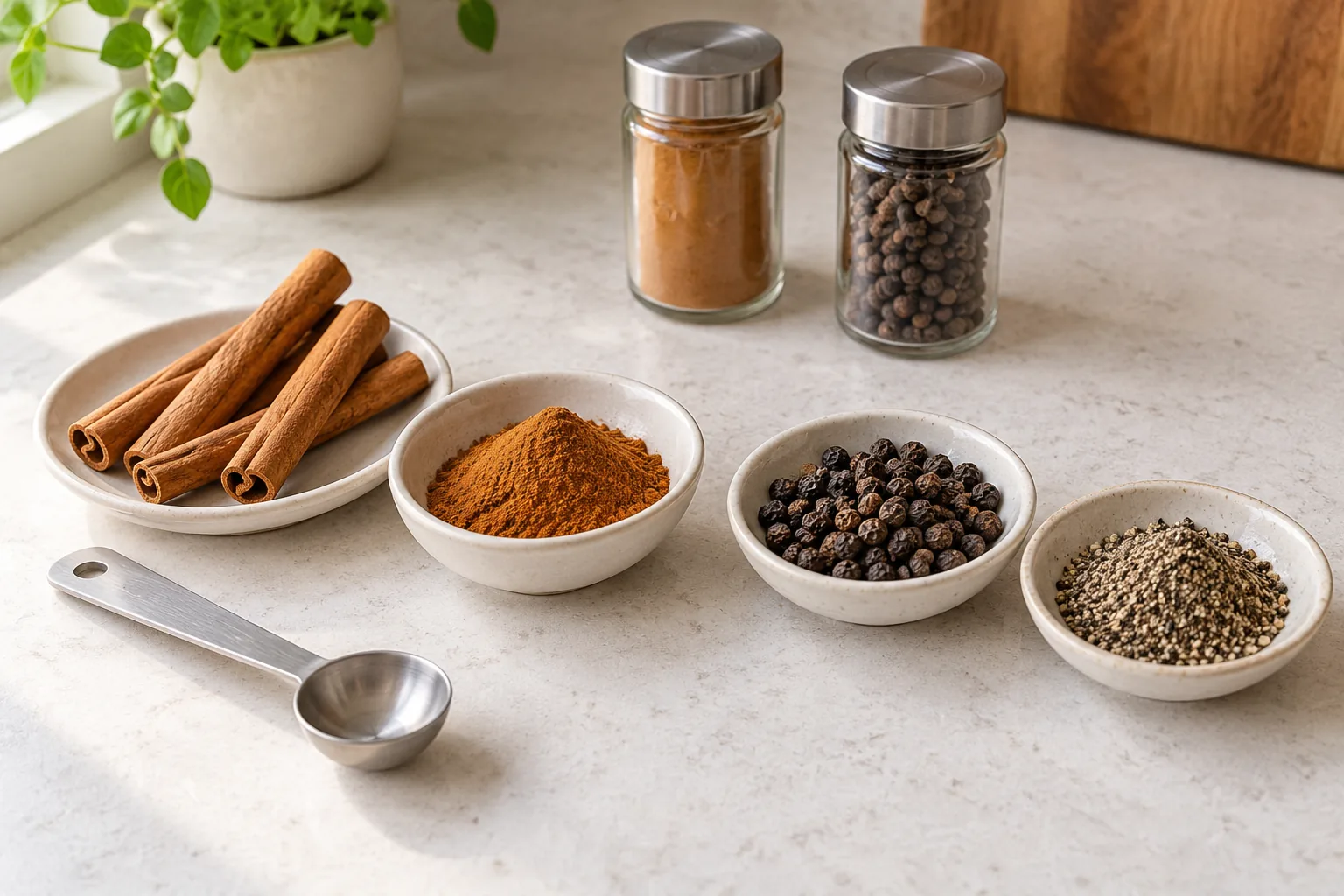
Buy ground spices for recipes that need a measured powder, and whole spices when the recipe uses them whole or you have a suitable tool and want to grind a small amount. A jar of ground cinnamon that goes into your oatmeal and baking can be a better purchase than cinnamon sticks you have no way to grind.
You can keep both forms of one spice and only one form of another. Start with the cooking you do: pepper for dinner, cinnamon for a familiar bake, cumin for the dish already on your list. A complete matching collection is not necessary.
This article contains affiliate links. As an Amazon Associate, Fondfolk earns from qualifying purchases.
Whole and ground do different jobs in a recipe
Ground spice becomes part of the food. A fine powder can be distributed through flour, a sauce or a seasoning mixture. Whole spices may be used intact for texture or steeped for flavor and removed, depending on the recipe. They may also be ground before being added.
Cinnamon shows the distinction clearly. King Arthur Baking explains that a stick can flavor an infused cream or stock and then be taken out. Ground cinnamon remains in the mixture. Replacing a removable stick with powder changes more than the appearance of the ingredient in your cupboard.
Read the method as well as the ingredient list. “One cinnamon stick, removed before serving” is not asking you to produce a teaspoon of powder. “Ground cinnamon, mixed with the flour” is asking for a powder that can spread through the batter. Buy for that job.
We may earn a commission from purchases through these links. Amazon search links open comparison results; check the selected item’s suitability.
| What the recipe asks for | A practical purchase | What to establish before changing it |
|---|---|---|
| A level teaspoon of ground cinnamon in a bake | Ground cinnamon | Whether the recipe specifies a cinnamon type or provides an alternative quantity. |
| Pepper ground over the finished dish | Peppercorns and a suitable pepper mill | Whether you already have a mill that accepts them. |
| Whole spices added and later removed | The named whole spices | Whether the author supports using powder in that method. |
| A measured blend such as pumpkin pie spice | The ready-made blend, or its specified ground ingredients | Whether you will use the individual spices in other food too. |
| Whole spices ground before cooking | Whole spices and equipment suited to those ingredients | How fine the recipe needs them and what the equipment instructions allow. |
Whole spices can hold their aroma longer
North Dakota State University Extension notes that whole spices such as cloves retain their quality longer than ground spices, and that aromatic compounds degrade as spices age. That gives whole spices a reason to be in the cupboard; it does not tell you the age or condition of the packet in front of you.
“Whole” is not a freshness certificate. Read the package information and give it a suitable storage place. Likewise, “ground” does not mean stale. A small jar bought for regular cooking may suit you very well.
I would buy whole peppercorns for a pepper mill I expect to use at dinner. I would buy ground cinnamon for several planned bakes unless grinding it is already part of the routine.
Choose a grinding tool before choosing hard spices
A pepper mill has a clear job. A mortar and pestle or electric spice grinder may suit other ingredients, but the tool must be suitable for the spice and the amount you want to process. Do not assume that a coffee grinder, blender or small chopper accepts every hard spice simply because it has blades.
The Cuisinart SG-10 manual gives separate directions for peppercorns, whole nutmeg, halved cinnamon sticks and whole cloves. It also specifies ingredient capacities. Those instructions belong to that model; they are not universal grinding times for machines already in your kitchen.
Read your own tool's instructions for permitted ingredients, loading, operation and cleaning. Keep fingers away from blades, and disconnect an electric grinder before cleaning as its manual directs. If the instructions do not support cinnamon sticks or nutmeg, buy those spices ground or choose another suitable tool.
Grind for the next recipe rather than automatically processing the whole packet. Collect the powder in a clean, dry bowl and measure after grinding. For a bake that needs fine powder, visible coarse pieces need more grinding with suitable equipment. If the equipment cannot produce the required texture, use a suitable ground product.
Measure the form the recipe names
One teaspoon of whole seeds is not a universal replacement for one teaspoon of powder. The whole pieces and the powder occupy space differently, and recipes may use them at different stages. There is no single whole-to-ground ratio that serves every spice and every dish.
When a recipe specifies ground spice, grind first, then measure the required powder. When it specifies whole spice, measure that form and follow the method. Use the recipe author's substitution when one is supplied; if a particular whole spice is central to an infusion or texture, keeping it can be the simpler choice.
We may earn a commission from purchases through these links. Amazon search links open comparison results; check the selected item’s suitability.
For small spoon quantities, I recommend the Simply Gourmet measuring cups and spoons set. Use level measuring spoons when the recipe calls for them, rather than estimating with a cutlery teaspoon. Keep a clean, dry spoon for the jar.
If the recipe gives a spice weight, use a scale suitable for that small amount. Display increments and accuracy are different questions. A whole-gram scale is not a reason to invent a gram conversion for a quarter teaspoon of cloves.
Cinnamon type is a separate buying decision
Cinnamon comes in different varieties as well as different forms. King Arthur's cinnamon guide distinguishes Ceylon from the cassia group, which includes Chinese cassia, Saigon or Vietnamese cinnamon, and Korintje or Indonesian cinnamon. It describes Ceylon as comparatively mild and delicate, and Vietnamese cinnamon as robust and spicy.
Look for a named type on the label if that distinction matters to your recipe. A cinnamon stick is not automatically Ceylon, and a jar described only as “ground cinnamon” does not give you enough information to assign a variety confidently.
For a first bake, follow the specified type and amount when the author gives them. When the recipe simply says cinnamon, use the ground cinnamon you have, then note the exact product if you want to repeat the seasoning. There is no need to buy several varieties before making one familiar recipe.
Buy a blend when it saves buying five separate jars
If your only plan is a recipe needing pumpkin pie spice, a small ready-made blend can be a sensible purchase. Making a blend becomes more appealing when you already use its individual ingredients. Count the amounts needed for your planned recipes before mixing a large jar.
For a pumpkin pie spice blend of ground cinnamon, ginger, nutmeg, cloves and allspice, use a complete measured formula. Keep the separate cinnamon in a recipe that asks for cinnamon as well as a blend; the extra entry may be deliberate.
Read a seasoning blend's actual ingredient list, too. A name alone does not establish its proportions or tell you whether salt or other ingredients have been added. If a recipe requires individual spices, swapping in a blend changes their balance unless the author gives that option.
For the spices you keep, compare airtight pantry jars with dry, well-fitting lids. Choose a jar that fits the small quantity you actually use, and preserve the original ingredient label.
Keep dates and aroma in their proper roles
Store spices tightly covered in a cool, dark, dry place, away from the heat and humidity around the stove or dishwasher. NDSU's storage advice supports those conditions. Measure on the counter rather than holding an open jar over a steaming pot.
Write the opening date on the container and retain the product's original date, identity and lot information. If you decant or grind some spice, put the name and preparation date on the new container too. Grinding does not make an older packet newly purchased.
NDSU recommends using aroma to judge potency. Open the jar away from steam and smell a small amount without breathing in a cloud of powder. A faint cinnamon aroma is a reason to question how much cinnamon flavor it will contribute. For a bake with a fixed formula, replace a weak spice rather than automatically adding much more.
That is a quality assessment, not a safety test. USDA explains that disease-causing bacteria do not generally change a food's smell, taste or appearance. Do not use aroma to clear a recalled product or a jar with uncertain contamination. If you find insects or webbing, University of Minnesota Extension advises discarding infested food and inspecting other stored packages.
Replace the spice you need for the next dish. Keep the ones you still want to use, buy smaller amounts where available, and let your recipes decide whether the next jar should contain powder, seeds or sticks.
Build a spice list from meals you repeat
Write down the next few dishes you actually expect to cook and mark which spices appear more than once. Those are the jars most likely to earn their space. A large collection bought for an imagined future cuisine can leave you searching through old jars while still missing the one powder tonight’s recipe needs.
Keep an occasional spice tied to a specific recipe. If the recipe needs a prepared blend, compare the cost and convenience of one small blend with the individual jars you would otherwise buy. The useful choice depends on your cooking, not on whether a whole-spice collection looks more serious.
Do a small grinding trial before the main mixture
When a recipe permits freshly ground spice, grind a small amount with suitable equipment before starting the batter or sauce. Check whether the result is fine enough for the intended job. Coarse fragments that work in one dish may feel unpleasant in a smooth filling.
Measure the finished form the recipe requests, using its own instructions. Do not empty an estimated spoonful of whole spice into a grinder and assume the powder must represent the same volume. Keep the tool clean and dry according to its instructions, especially when it also processes strongly flavored ingredients. A small reliable preparation routine is more useful than grinding every jar in advance.