This article contains affiliate links. As an Amazon Associate, Fondfolk earns from qualifying purchases.
A casserole dish needs room for the whole meal: the lentils beneath the mashed potatoes, the sauce between the lasagna sheets, and the space above them before anything starts bubbling. Match the recipe's inside dimensions, depth and material first. A familiar “9 × 13” label or a three-quart capacity does not settle all three.
Measure the dish before making the filling. That is a much easier moment to discover that its generous-looking handles account for several inches of the advertised length.
Read the recipe's pan instructions all the way through
Find the specified dish size, material and depth, along with any instruction about how full to fill it. Read the final baking steps, too. A dish suitable for baking may not be suitable for the recipe's broiler finish, and a storage lid may not belong in the oven at all.
Look at what goes into the dish after the main filling. Mashed potatoes, biscuit dough and a thick layer of cheese all need their own space. A pan that accommodates the sauce alone has passed only part of the test.
When the recipe specifies a particular pan, use the closest suitable match you already own. If it gives only “a casserole dish,” look for a capacity or dimensions elsewhere in the instructions before choosing one by appearance.
Measure the inside and the outside separately
Set the empty, cool dish on a level surface and use a ruler to record these measurements. King Arthur Baking's pan guide distinguishes the inside measurements useful to a recipe from the outside measurements a manufacturer may list.
| Measurement | Where to measure | What it tells you |
|---|---|---|
| Inside length and width | Between the inside walls, without the rim or handles | Whether the cooking area resembles the recipe's specified pan |
| Inside depth | From the inside bottom to the rim | The available height for food and headspace |
| Outside length and width | Across the widest points, including handles | Whether the dish fits the oven, refrigerator shelf or carrier |
| Overall height with a lid | From the base to the highest point of the closed lid | Whether the covered dish fits its intended storage space |
If the sides slope, measure the base as well as the opening. A broad rim can hide a noticeably smaller bottom. Rounded corners also reduce the space available compared with an imaginary straight-sided box of the same length and width.
Write “inside” and “outside” beside the numbers. Six months from now, a note saying only “14 inches” will be less helpful than it looks today.
Find the capacity with measured water
We may earn a commission from purchases through these links. Amazon search links open comparison results; check the selected item’s suitability.
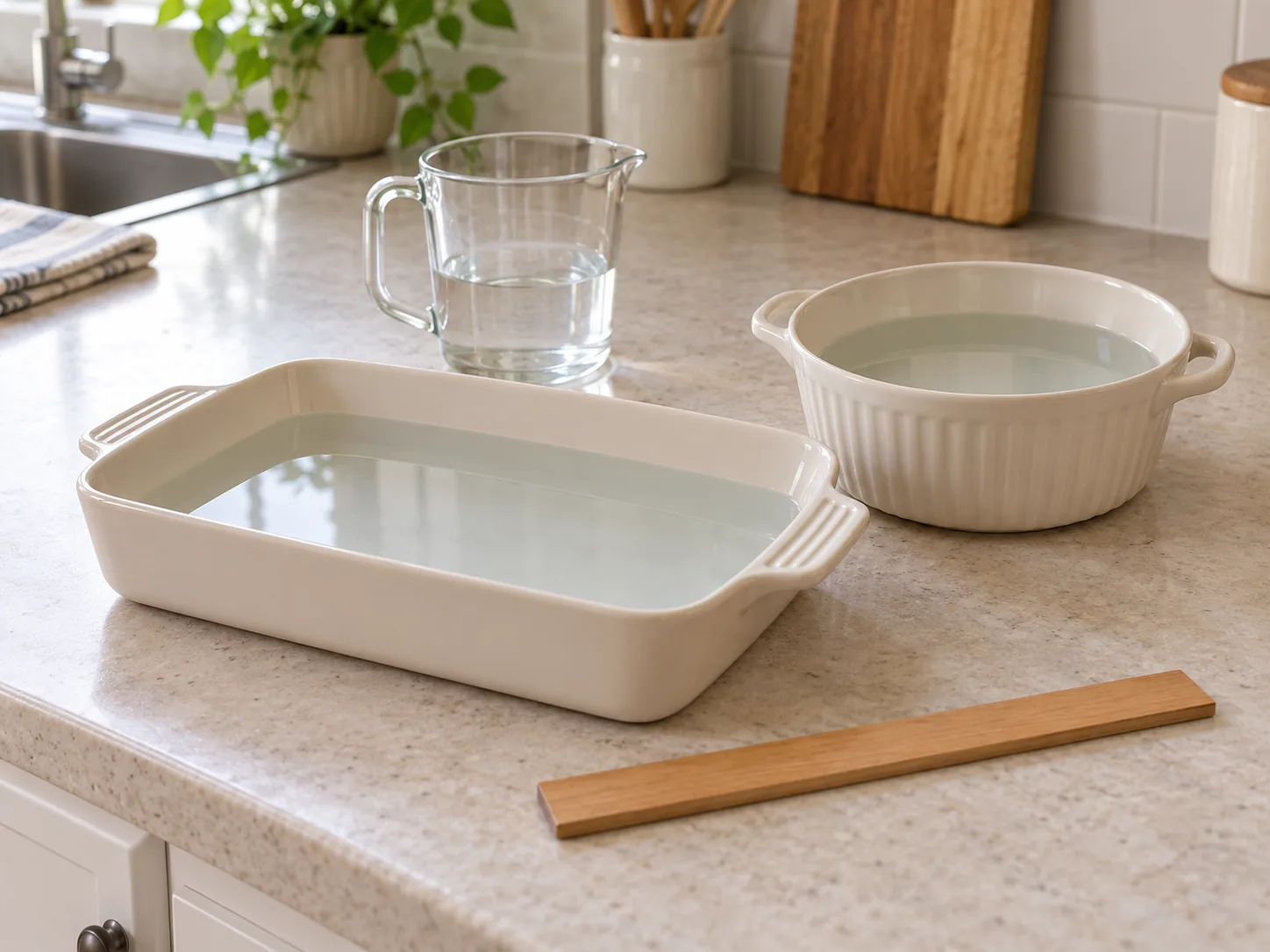
Water gives you a direct volume measurement without guessing how thick the walls are. Use a clean, room-temperature dish and a liquid measuring jug with readable markings.
- Put the dish on a stable, level surface near the sink. Keep it there throughout the measurement.
- Add room-temperature water in measured amounts, keeping a running total. One-cup additions are easy to track; use smaller additions near the level you want to measure.
- Record the total at that level and measure how far the water sits below the rim. Label the record clearly, such as “8 cups, with this much space below the rim.” This is a measured fill level, not an automatic recommendation for a recipe.
- If you also measure to the brim, record that separately as brimful capacity. Remove water with the jug before lifting a heavy dish, then empty and dry it completely.
Four US cups equal one US quart. A dish that holds 12 cups right to the top therefore has a three-quart brimful capacity; it cannot accommodate three quarts of bubbling casserole with room to spare.
King Arthur's capacity explanation makes the same essential distinction between the volume a pan can hold and the amount it should contain during baking. The correct headspace depends on the recipe. Cake batter that rises and a cooked vegetable filling with a potato topping need different allowances; there is no single fill fraction for every casserole.
Do this with a cool dish, never one straight from the oven. Pyrex warns against adding liquid to hot glassware because sudden temperature changes can cause breakage. Follow the care instructions for your own dish, including any restrictions on soaking.
Equal capacity can still mean a different bake
Imagine dividing the same amount of filling between a wide, shallow dish and a narrow, deep one. The narrow dish creates a thicker layer of food and less exposed surface. That changes how the center heats and how much topping is available to brown.
Capacity alone therefore cannot promise the recipe's baking time. A deeper replacement may leave you with browned cheese before the middle is ready; a shallower one may expose more filling to drying. Material matters too. King Arthur's comparisons of glass, metal and stoneware show that changing the pan can change baking results.
Preserve the recipe's specified pan when timing is important. If you change it, follow the dish manufacturer's limits and the recipe's doneness instructions, observing from the first suggested checking point. Do not halve or double the baking time simply because you halved or doubled the number of dishes.
Leave room for the potato topping
Our mushroom and lentil shepherd's pie specifies a 9 × 13-inch dish for six portions. It has a lentil-and-mushroom filling and a mashed-potato topping; both belong in the fit decision.
Choose the dish before cooking the filling. Preserve the room needed for the topping and bubbling edges instead of squeezing everything to the rim. The recipe calls for a 400°F oven, with a bubbling filling and a center reaching 165°F. A browned ridge of potato alone does not establish that the center is ready.
If your dish is substantially smaller or shallower, choose a suitable one before starting. Dividing the recipe between smaller dishes creates a changed baking arrangement that needs its own monitoring. The one-oven Thanksgiving guide helps account for the additional oven space that choice would require.
Choose a dish for the measurements you need
We may earn a commission from purchases through these links. Amazon search links open comparison results; check the selected item’s suitability.
I recommend the Caraway ceramic-coated 9 × 13-inch rectangle pan when its footprint and usable depth suit the recipe. It is coated metal, rather than a solid ceramic dish. Caraway identifies a 13 × 9-inch baking surface and a 15-inch overall length with handles; measure the actual interior depth before assigning it a deep casserole.
For readers choosing a coating made without PFAS, Caraway states that this coating is made without PFAS, PTFE and PFOA. That specific description is more useful than treating “non-toxic” as a promise about every material or cooking condition. Its bakeware instructions prohibit broiling and heating the pan empty, set a 550°F oven maximum, and call for soft wood or silicone utensils and cooling before washing.
We may earn a commission from purchases through these links. Amazon search links open comparison results; check the selected item’s suitability.
A dish from the MALACASA four-piece ceramic baking-dish set is another option I recommend when its measured interior matches the recipe. Do not read a listed overall length as usable cooking length. Measure the piece you own, including the depth, and follow its own care directions; being the largest dish in the set does not establish that it replaces every 9 × 13-inch pan.
Before filling either dish, place it in the cold oven to confirm that it fits with the clearance your oven requires, then remove it before preheating. Include the handles when checking refrigerator or carrier space, and allow room to grasp them securely with dry oven mitts.
Keep the measurements with the recipe after cooking. A note naming the dish, its usable fill level and the actual baking result gives next year's casserole somewhere definite to go.
Check the dish before mixing the filling
Measure and test-fit the empty dish while it is clean, cool and easy to move. Confirm its usable depth and the space needed above the filling. If the required recipe capacity is uncertain, resolve it before combining ingredients that are difficult to divide afterward.
Set the dish on the tray the recipe intends you to use and check the whole footprint in the cool oven. Handles, tray rims and a tall lid can change the fit even when the base dimensions seem right. Include the room needed to lift it level with oven gloves.
Write down what made the chosen dish suitable
Keep a short note with the recipe naming the dish’s inside measurements, material and any fill instruction. A photograph of the empty dish beside a ruler can help identify it later. Do not reduce that note to the brand name alone; one maker may sell several depths under the same familiar shape.
If a different pan is needed next time, repeat the fit decision rather than inheriting the old cooking estimate automatically. The important comparison is the depth of the food and the equipment’s intended use. Equal brimful volume does not prove equal baking behavior or safe broiler use.