One oven can handle a generous Thanksgiving dinner when the menu gives it one clear job at a time. Start with the main dish, reserve its temperature and pan space, then choose sides that cook elsewhere. A mushroom and lentil shepherd’s pie, a green vegetable and cranberry sauce already put plenty on the plate without three more baking dishes waiting at the oven door.
The first decision is what you want to eat. The next is where each dish will cook. Make those decisions together, before the shopping list becomes a promise to fit everything in.
Put the empty pans in the cold oven
Use the pans you intend to cook in, including their handles and any lids. Place them on the shelves you plan to use, close the door and confirm that you can remove each one safely. Follow your oven’s instructions for rack position and the space needed around cookware for circulation; a pan fitting through the door is only the first part of the check.
Measure the outside dimensions, not just the size printed on a recipe. A 9-by-13-inch baking surface may have handles extending beyond that rectangle. Height matters too, especially with a deep casserole, a lid or a roast projecting above the pan.
Have a clear, heat-resistant place for the pan when it comes out. The empty stretch of counter beside the sink may disappear once the vegetable pot, gravy jug and used mixing bowls arrive. Reserve that landing place while the pans are still cold.
Choose a menu with one oven dish
For six people, this menu keeps the final oven block uncomplicated:
| Dish | Cooking or serving location | What must be ready first |
|---|---|---|
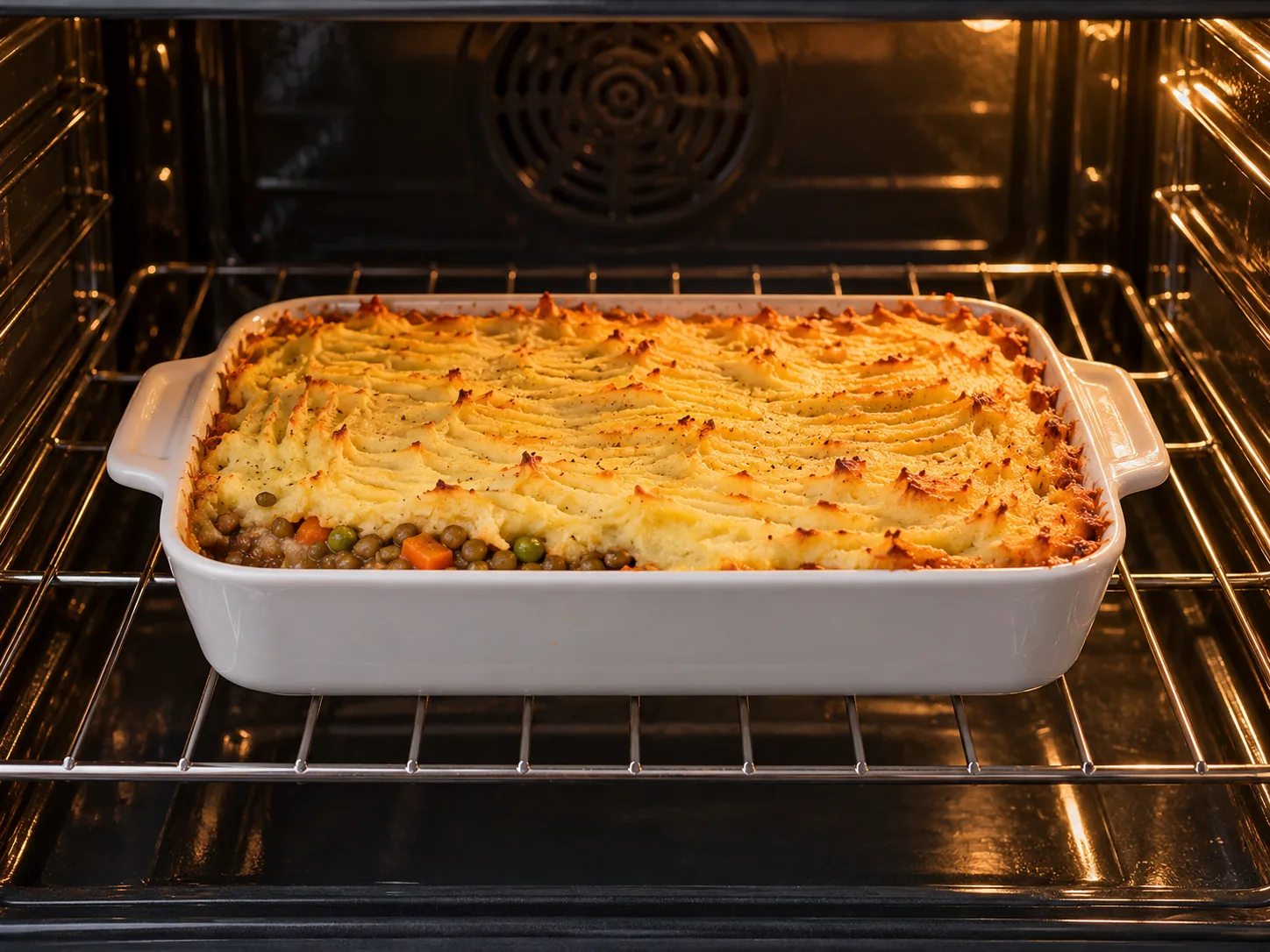
| Mushroom and lentil shepherd’s pie | One 9-by-13-inch dish in the oven | Cooked filling and potato topping; lentils already cooked and drained |
| Green beans or another chosen green vegetable | Stovetop | Washed and prepared according to its recipe |
| Optional mushroom gravy | Separate saucepan | Recipe completed or enough time allowed for safe reheating |
| Cranberry sauce | Served as its recipe or package directs | Prepared and stored according to those directions |
| Bread | Served without warming | Sliced and ready |
| Dessert | Prepared earlier | Baked, cooled and stored according to its own recipe |
The pie already includes potatoes, lentils, mushrooms, carrots and peas. I would put the extra effort into a green side rather than another potato dish. The vegetarian Thanksgiving centerpiece guide explains the main in more detail.
Ask about dietary needs, and read the ingredients in stock, Worcestershire sauce, bread and dessert. The pie’s written recipe uses vegan Worcestershire but contains milk and butter; vegetarian does not mean vegan or dairy-free.
Reserve the oven block before adding another dish
The pie calls for a conventional 400°F oven, an estimated 20–25-minute bake and a ten-minute rest. It must be bubbling and reach 165°F in the center before that rest begins. Its complete preparation takes an estimated 90 minutes, and the lentils are required already cooked.
For a 5 p.m. dinner, use the following as an illustrative allocation. It assumes freshly made components; a refrigerated assembled pie needs a different reheating allowance.
| Oven block | Pan and temperature | Finish condition and next step |
|---|---|---|
| Earlier or the day before | Dessert’s own pan and recipe temperature | Finish its full baking, cooling and storage before the dinner block. |
| Before 4:25 p.m. | Oven preheated to 400°F; correct shelf ready | Pie filling and topping cooked and assembled. |
| 4:25 to about 4:50 p.m. | One 9-by-13-inch pie dish at 400°F | First check at 4:45; continue until bubbling and 165°F in the center. |
| Ten minutes after the pie is done | Pie rests outside the oven in a safe landing place | Finish the stovetop vegetable and serve after the full rest. |
Leave the last row flexible. If the pie needs longer, dinner moves with it. Its rest is not a spare baking slot for another casserole that needs 30 minutes.
The detailed final dinner timing plan coordinates those last burner and serving jobs. Keep the earlier shopping and preparation on the Thanksgiving timeline.
Match the baking dish to the food
This article contains affiliate links. Fondfolk may earn a commission if you buy through them. As an Amazon Associate I earn from qualifying purchases.
We may earn a commission from purchases through these links. Amazon search links open comparison results; check the selected item’s suitability.
I recommend the Caraway 9-by-13-inch rectangle pan as an option when its dimensions and depth suit the recipe. Caraway lists a 13-by-9-inch baking surface, an overall length of 15 inches with handles, and oven use up to 550°F. That matches this recipe’s stated footprint and 400°F setting; it does not verify the assembled pie’s fill height. Use a sufficiently deep 9-by-13-inch dish with room above the food, rather than filling a shallow pan to its rim.
When choosing cookware sold as non-toxic, I prefer specific materials information. Caraway identifies this pan as ceramic-coated aluminized steel and says the coating is made without PTFE, PFOA or PFAS. Follow its care and use directions. The material description is more useful than assuming every product carrying a “non-toxic” label has the same construction or limits.
A suitable dish already in your cupboard can do the job. Check its oven rating and handling instructions, including any restrictions on moving between hot and cold conditions.
Move a dish only when the other appliance suits it
A slow cooker can be useful for a different menu that needs mashed potatoes alongside its main. Fondfolk’s slow-cooker mashed potatoes with chives makes ten side portions in a 6-quart slow cooker. Its written method uses HIGH for 3–4 hours until the potatoes crush easily with a fork, followed by mashing and finishing. That is an early job, not a last-minute way to free the oven.
We may earn a commission from purchases through these links. Amazon search links open comparison results; check the selected item’s suitability.
If you already own the Our Place Dream Cooker, its slow-cook mode may provide another cooking location for a recipe suited to that exact model. I would confirm the recipe, liquid requirement and fill limits in its user manual before assigning it a dish. A 6-quart capacity alone does not establish that the potato recipe transfers unchanged. The dinner above does not need an additional appliance.
Give any countertop cooker the clearance, stable surface and power connection its manual requires. For the Dream Cooker, the manual prohibits extension cords. An available corner of counter is useful only when the appliance can operate there as directed.
Reheat refrigerated leftovers on the stove, in the microwave or in the oven to 165°F before transferring them to a suitable preheated cooker for holding at 140°F or hotter. Do not use a slow-cook or keep-warm setting to bring cold leftovers up to temperature for this plan. Kansas State University’s slow-cooker safety guidance sets out that sequence. The make-ahead potato guide covers the separate reheating job.
Resolve conflicts while the menu is still on paper
If two recipes need different oven temperatures at the same time, move one to an earlier block or choose another dish. Averaging their temperatures creates a new cooking method that neither recipe supports. Even matching temperatures do not prove that both pans fit with adequate circulation.
We may earn a commission from purchases through these links. Amazon search links open comparison results; check the selected item’s suitability.
Write any holding period into the plan, with the appliance responsible for it. FDA recommends keeping hot food at 140°F or above, measured in the food with an instant-read thermometer. A switched-off oven or covered pan is not a temperature-controlled holding plan.
I recommend the OXO Digital Triple Kitchen Timer for separate bake, rest and stovetop reminders, with a written note naming each. Before cooking starts, each dish should have a pan, a place, a temperature and a finish time. When one is missing, change the menu while dinner is still a list.
Reserve room for the last check
An oven block needs enough time to inspect the dish, measure its center where required and return it to the oven if it is not finished. Do not book the next recipe to start at the exact moment the first estimate ends. That schedule leaves no place for ordinary variation in food thickness or starting temperature.
Keep the serving dish and heatproof landing space clear. Removing one hot pan should not require moving another onto an unsuitable counter or the edge of the sink. The route from oven to serving area is part of the capacity plan.
Choose what can stay off the final schedule
A dessert finished earlier, bread served without warming and a cold side can remove several last-minute oven requests. Make those choices while the menu is flexible, not after every guest has promised a baked dish. Ask contributors about their final heating needs before confirming their contribution.
If a dish changes, revise the temperature, pan space, preparation and holding notes together. A smaller pan may still require a different cooking window; a different appliance may have its own capacity limits. Keep one main oven job clear rather than averaging temperatures or shortening checks to make incompatible recipes overlap.