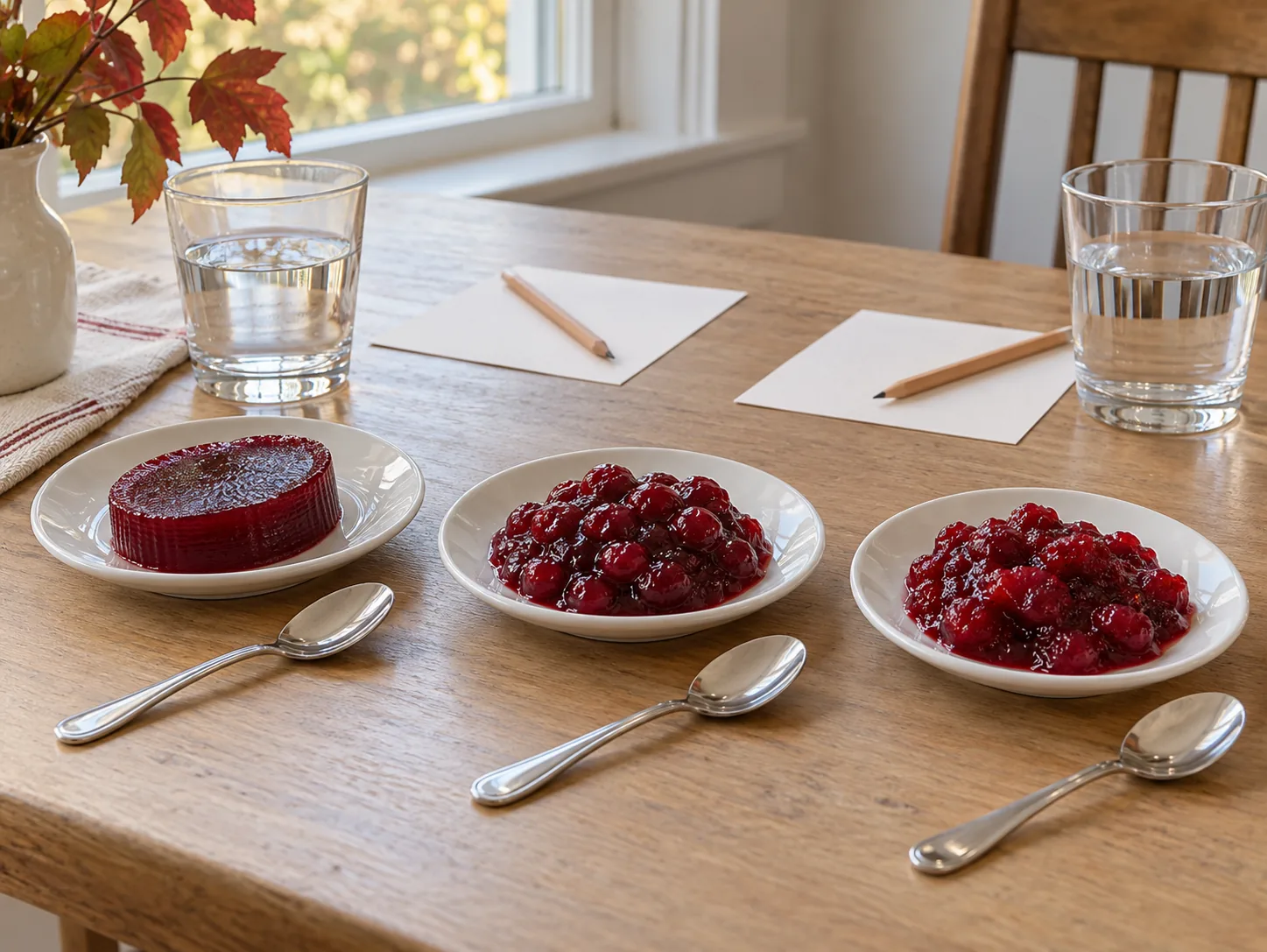
Some people want a smooth slice of cranberry sauce that holds its shape. Others want berries they can spoon beside a forkful of dinner. Put three small samples on the table before Thanksgiving and let everyone describe what they like: jellied, canned whole berry and a simple homemade whole-berry sauce.
You are choosing a sauce for your meal, so keep the comparison small. Use the same serving temperature, record the actual products and recipe, and taste before discussing favorites. A preference for the familiar jellied slice is as useful a result as enthusiasm for the pot you made yourself.
Choose three clearly identified samples
Buy one jellied cranberry sauce and one canned whole-berry sauce. Choosing the same brand for those two can make the shopping simpler, but it does not make their formulas identical. Read both labels rather than assuming that texture is their only difference.
Make the plain sauce below as the third sample. Leave orange zest, cinnamon, nuts and other additions out of this first comparison so they do not become the deciding feature. There is time to try an orange version after you know whether the table wants a smooth or berry-filled sauce.
Write the brand, exact product name and opening date for the cans. For the homemade sauce, record the recipe, berry brand if known, whether the fruit was fresh or frozen, and the preparation date. Keep the ingredient information available, especially when guests have dietary requirements. Letter codes can hide a brand name during tasting; they should never hide ingredients someone needs to avoid.
Make a plain whole-berry sauce ahead
This three-ingredient version uses the proportions in Ocean Spray's whole-berry cranberry sauce. The cooling directions below use prompt refrigeration rather than waiting for the whole pan to become cold on the counter.
Makes: About 2¼ cups, the source recipe's stated yield. Active preparation and cooking: About 20 minutes, plus chilling until cold throughout. Make it the day before the tasting.
Ingredients
- 1 package (12 ounces) fresh or plain frozen cranberries
- 1 cup granulated sugar
- 1 cup water
This article contains affiliate links. As an Amazon Associate, Fondfolk earns from qualifying purchases.
We may earn a commission from purchases through these links. Amazon search links open comparison results; check the selected item’s suitability.
Use US measuring cups. For this comparison, keep the full sugar amount and the plain water. A different sweetener or orange juice would make a different sample.
Method
- Sort the cranberries, discarding damaged or spoiled fruit. Rinse under running water and drain. Use plain frozen berries without thawing first.
- Put the sugar and water in a medium saucepan and bring to a boil, stirring to dissolve the sugar. Add the cranberries and bring the mixture back to a boil.
- Lower the heat to maintain a gentle boil. Cook for 10 minutes, stirring occasionally, then remove from the heat.
- Transfer to small, shallow, heat-safe containers and refrigerate promptly. Keep the fridge at 40°F or below. Do not wait for the entire batch to cool on the counter; FoodSafety.gov recommends shallow containers and prompt chilling. Cover for storage and chill until cold throughout before tasting.
Keep the finished sauce refrigerated and use it within four days of making as a conservative leftover limit. This is a refrigerated sauce, not a home-canning recipe. Our guide to fresh, frozen and dried cranberries explains why dried fruit is not a direct replacement here.
Set out enough for a small comparison
We may earn a commission from purchases through these links. Amazon search links open comparison results; check the selected item’s suitability.
For six tasters, allow one tablespoon of each sauce per person: six tablespoons of each style, or 18 tablespoons total. That gives each person enough for an initial taste and a second small taste without filling three serving bowls. Keep the remaining sauce covered in the fridge.
You will need six small plates, tasting spoons, water, pencils and a copy of the scorecard for each person. Mark three separate positions on each plate A, B and C, or use three small dishes. Give every sauce its own serving utensil and every person clean tasting utensils. Used tasting spoons do not go back into the shared containers.
Chill the canned samples according to their storage instructions so all three sauces begin the tasting cold. Portion them just before everyone sits down. If you want a second round with food, provide the same small piece of plain bread or another agreed accompaniment for every sample, with its ingredients available too.
Taste quietly first, then compare notes
Start by looking at the sample and describing its texture. Does it hold a slice, spread smoothly or contain distinct berries and skins? Those details can explain a preference more clearly than a single score.
Taste a little sauce on its own and note the sweetness and tartness separately. High sweetness is not automatically good or bad; someone may prefer a tart sauce beside rich potatoes and gravy. Take a sip of water between samples, then move to the next one.
Let people finish their first notes before announcing a favorite. With six tasters, two can start at A, two at B and two at C, continuing around the samples. This is a simple household comparison, not a scientific test, but varying the starting point avoids making everyone begin with the same sauce.
Use a second small taste to answer the meal question: which sauce would you actually want beside dinner? Someone may enjoy a sauce by itself yet prefer another with the chosen accompaniment. Record both answers if they differ.
Copy this cranberry sauce scorecard
Taster: __________ Date: __________
Serving temperature/conditions: __________ Accompaniment, if used: __________
For sweetness and tartness, use 1 = very little, 3 = moderate, 5 = very strong. For “want with dinner,” use 1 = would not choose, 3 = would happily eat, 5 = first choice. Leave a field blank if you cannot decide.
| Sample | Texture in your words | Sweetness 1–5 | Tartness 1–5 | Want with dinner 1–5 | One reason |
|---|---|---|---|---|---|
| A | __________ | ___ | ___ | ___ | __________ |
| B | __________ | ___ | ___ | ___ | __________ |
| C | __________ | ___ | ___ | ___ | __________ |
My preferred sauce: __________
What I would keep or change next time: ______________________________
The host keeps a separate key:
| Code | Brand/exact product or recipe | Opened or made on | Fresh/frozen berries; any changes |
|---|---|---|---|
| A | __________ | __________ | __________ |
| B | __________ | __________ | __________ |
| C | __________ | __________ | __________ |
Turn the notes into a dinner decision
Reveal the sample key after everyone has written. Count each person's first choice, then read the reasons. “Too many skins” points to texture; “I want more tartness” points to flavor. The same low score can mean very different things.
If the group splits between jellied and whole berry, serve two small dishes and label them. For a Friendsgiving potluck, assign those two versions explicitly so nobody has to guess what “bring cranberry sauce” means.
For a smaller meal, keep the comparison to the two people eating it and choose what they prefer. The Thanksgiving-for-two menu can help you decide how much else belongs on the table.
Refrigerate untouched reserves promptly and follow the package's instructions for opened canned sauce. Keep this tasting within two hours without safe cold holding, or one hour if the temperature is above 90°F; discard perishable samples left out beyond that limit. Do not return tasted portions to the storage containers.
Save the key and the preference notes with your menu. Next year, “whole berry, not too sweet” will tell you more than remembering that someone liked the red bowl.
Keep the samples comparable
Serve the tasting portions under the same conditions and use a separate utensil for each sauce. If one sample is warm and another is cold, note that difference rather than treating the scores as a clean comparison of style alone. Start with plain samples before adding a bite of bread or another accompaniment.
Keep the can labels and homemade ingredient record beside the sample key. A preference for one texture does not tell you whether another guest can use its ingredients. Let the tasting answer what the group enjoys, while the labels answer what was actually served.
Use the result to simplify the holiday meal
Choose the sauce style the table wants and the preparation that fits your cooking day. A clear preference for a canned style can remove a stovetop job. A preference for homemade whole-berry sauce gives you a dish that can be prepared and chilled according to its recipe before the final meal rush.
Do not turn a mixed set of preferences into a large extra production. Two small clearly identified choices may be enough if guests differ strongly. Keep the scorecard as a shopping note, not a permanent ranking: the point is to make a dinner decision, and a future group may choose differently.