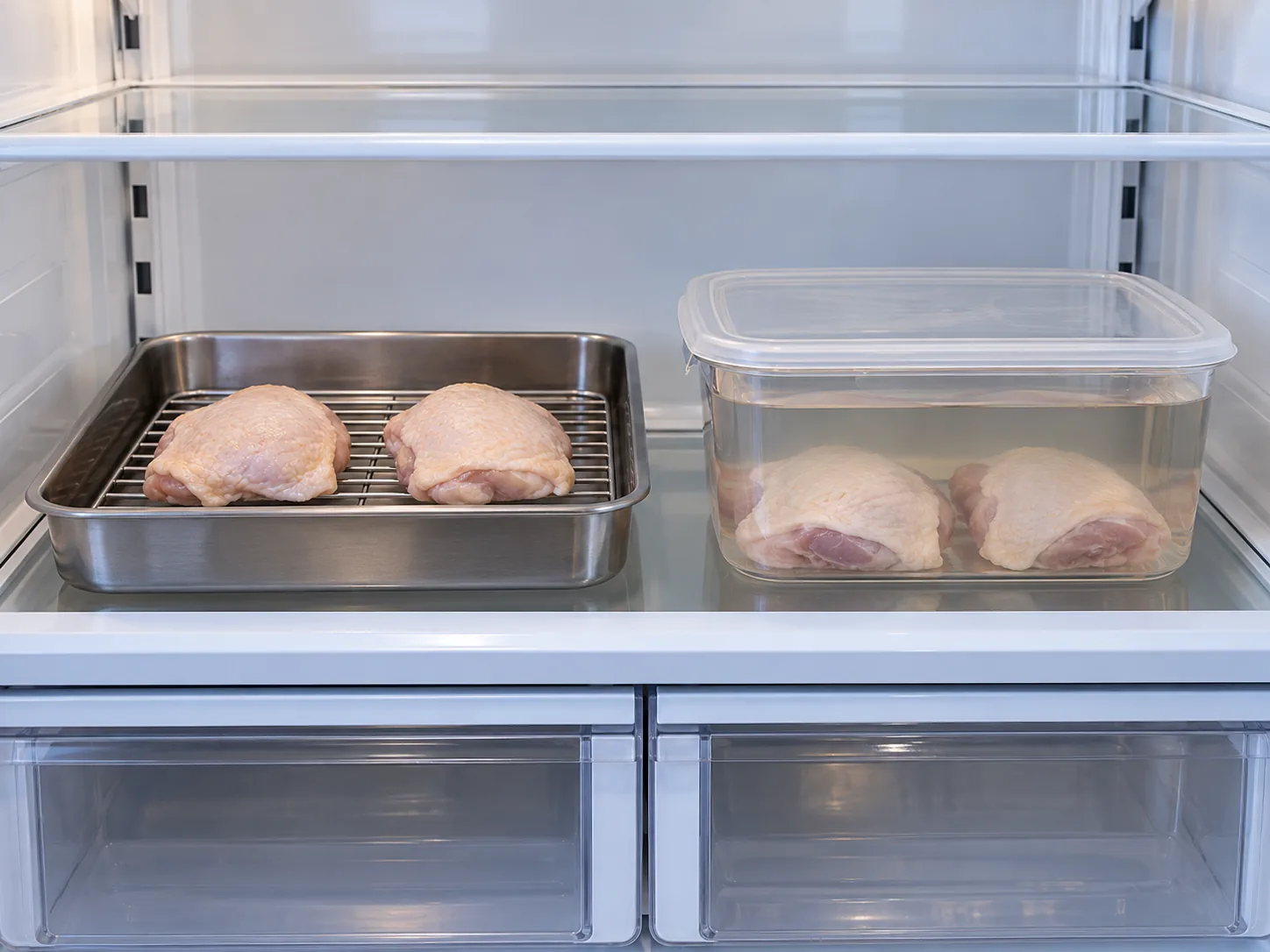
Dry brining is usually the easier choice when refrigerator space is tight: you season the meat directly, then refrigerate it for the time specified in the recipe. Wet brining means submerging it in a measured saltwater solution, which needs a larger, covered container. Both methods need careful measuring and cold storage. Neither is a step to add automatically to every chicken or turkey recipe.
I prefer choosing the method after reading the meat label and looking at the space available in the fridge. A covered container that fits comfortably beside the other groceries is more useful than a brining plan that leaves nowhere for tomorrow’s dinner.
This article contains affiliate links. Fondfolk may earn a commission from qualifying purchases. As an Amazon Associate I earn from qualifying purchases.
What changes between the two methods?
With a wet brine, salt dissolves in added water before the meat goes in. Salt affects muscle proteins and can help poultry retain moisture during cooking, as explained in USDA’s brining guidance. The salt concentration, the cut and the time spent in the solution belong together; changing one can change the result.
A dry brine puts the measured salt directly on the meat, without a separate bath of water. It is advance seasoning rather than a reason to leave food unrefrigerated. Follow a recipe written for the cut you have, including its instructions for covering and its refrigeration time.
| Your decision | Dry brine | Wet brine |
|---|---|---|
| Where the salt goes | Directly onto the meat, as the recipe directs | Into a measured quantity of water |
| Refrigerator setup | A suitable food-safe container or bag, supported to contain leaks | A covered food-safe container large enough for the meat and liquid |
| What to measure | The recipe’s salt amount for its specified cut and weight | The recipe’s salt and liquid amounts for its specified cut |
| Main practical advantage | No large volume of brine to carry or discard | A recipe can specify a complete immersion method |
| What needs attention | Even application, existing seasoning and the prescribed time | Full submersion, a secure cover, spill control and cold storage |
| What it cannot replace | Safe cooking and a temperature check | Safe cooking and a temperature check |
This is a choice between two recipe methods, so use the complete method you choose. Taking the salt quantity from a dry-brine recipe and adding it to an unrelated amount of water does not turn it into a dependable wet brine.
Read the package before reaching for salt
Look at the ingredient list and any wording about added solution, seasoning, marinating or self-basting. Poultry may already have had a solution added during processing. The USDA fact sheet on basting, brining and marinating explains these treatments.
If the package lists salt, or describes the meat as pre-brined or seasoned, do not apply a brine intended for untreated meat without an explicit adjustment from the recipe or producer. Kosher poultry also deserves a check of the product’s preparation and seasoning guidance. Choosing an unseasoned cut that matches the recipe is simpler than trying to guess how much salt it already contains.
The same applies to the rest of the recipe. A salty spice blend, seasoned butter and stock may all contribute salt later. Keep the complete ingredient list in view rather than treating the brine as an isolated step.
An unbrined recipe is a valid starting point, too. If the recipe specifies unbrined, unseasoned turkey, preserve that instruction. More preparation does not automatically make it a better dinner.
Match the salt as carefully as the cut
A spoonful is a volume, not a fixed weight of salt. Crystal size and shape affect how much fits into it. Morton’s conversion guide distinguishes its salt types, while Diamond Crystal describes its kosher salt’s hollow crystals. “Kosher salt” on two packages does not mean their spoonfuls can be exchanged without checking.
We may earn a commission from purchases through these links. Amazon search links open comparison results; check the selected item’s suitability.
I recommend Diamond Crystal kosher salt when it is the salt named in the recipe. When the recipe supplies a salt weight, use that weight and the specified type of salt. When it supplies only teaspoons or tablespoons, use the named brand and type, or the recipe author’s stated substitution. If it gives neither a weight nor a clear salt specification, choose a better-specified brining recipe before starting.
For weight-based recipes, I prefer the KitchenAid dual-platform scale. Tare the empty container and use a platform suited to the required amount, following its load limits. A finer display alone does not establish that a scale measures every tiny quantity accurately.
We may earn a commission from purchases through these links. Amazon search links open comparison results; check the selected item’s suitability.
For recipes that do specify volume, I recommend the Simply Gourmet measuring cups and spoons already on our kitchen-tool list. Use the exact measure the recipe calls for; a level tablespoon and a heaped spoon are different amounts. Measuring spoons cannot resolve a missing salt-brand instruction.
There is no universal tablespoon rule here. A whole turkey, a turkey breast and thin chicken pieces are different starting points, and a wet brine adds another variable: how much water surrounds the meat.
Make room for the whole process
Before preparing a wet brine, put the empty container in the refrigerator to confirm that its lid closes and the door shuts. Allow for the weight of the meat and liquid when deciding whether you can move it steadily. USDA identifies food-grade plastic, stainless steel and glass as suitable container materials. Use equipment intended for food contact, in sound condition, and follow its care instructions.
The container needs to hold the meat below the liquid while staying covered. A loose bag that can tip over is not a complete setup; support it in a suitable container that will catch leaks. Keep raw poultry and its liquid separated from foods that are ready to eat.
A dry brine avoids the added liquid, but it still needs secure refrigerator space. Use the recipe’s food-safe bag or container and place it on a rimmed tray to catch any drips. Do not replace a prescribed covered method with an uncovered arrangement simply because a photograph looks appealing.
If neither setup fits, use a smaller cut with a matching recipe or skip brining. This decision is easiest before the meat is unwrapped. The same habit helps with planning Thanksgiving around one oven: assign the equipment before filling it.
Keep the poultry cold, and keep its original clock
USDA’s turkey guidance calls for refrigeration at 40°F or below during brining and no more than two days in the brine. That is an upper limit, not a recommended soak for every cut. Follow a shorter recipe time when specified.
Brining also does not restart raw poultry’s storage time. Fresh poultry, or poultry thawed in the refrigerator, generally has a one-to-two-day refrigerated window before cooking. Count the brining time within that window. Buying poultry, keeping it for two days and then beginning a further two-day brine is not the same plan.
If a wet-brine recipe begins by heating its ingredients, prepare it early enough to chill the liquid before adding the poultry; keep the meat and brine at 40°F or below. Do not use the raw bird to cool warm liquid. Plan refrigerator thawing if the chosen method needs a chilled brining period after thawing; poultry thawed by cold water or microwave must be cooked immediately, as explained in USDA’s thawing guidance.
Discard used brine. Wash hands, utensils and surfaces after contact with raw poultry or its juices. Do not routinely wash raw poultry: splashes can spread contamination around the sink and counter.
Brining is not a curing or preservation method
A dinner brine seasons raw meat before cooking. It does not make chicken safe to keep on the counter, extend its refrigerated storage indefinitely or turn it into shelf-stable food.
Making bacon, ham or other cured products requires a separate, validated method with its own ingredient specifications and controls. The National Center for Home Food Preservation treats curing and smoking as distinct preservation work. Do not substitute curing salts into an ordinary dinner brine or assume that extra salt makes an improvised process safe.
Once your chosen brining period is finished, follow the matching cooking recipe and place the meat thermometer correctly. Poultry still needs to reach 165°F, including the coldest areas you check. Seasoning can improve dinner; the thermometer tells you whether cooking is finished safely.
Choose a method you can finish without improvising
Before deciding between brines, write down the recipe’s salt type, measured amount, cut and timing. Check that you can keep the meat cold for the entire process and move its container safely. A wet brine that fits only when the refrigerator shelf is tilted is not a workable plan.
A dry brine still needs a suitable tray and protected refrigerator space. Smaller liquid volume does not remove the need to contain raw poultry and keep it away from ready-to-eat food. Compare the whole handling job, not only the mixing stage.
Leave the other seasonings attached to their recipe
A complete brined-roast recipe accounts for its own seasoning route. Combining the brine from one method with all the salt in another rub can change the result substantially. Read any instructions for gravy or cooking juices too, since a salted starting product can affect how those are seasoned.
If the package reveals an added solution after you have already chosen a brine recipe, pause and select instructions suited to that product. Do not rely on a quick rinse or an guessed reduction to make the two methods equivalent. Brining is an optional preparation technique, not a requirement for a good dinner or a correction to add automatically to every turkey.