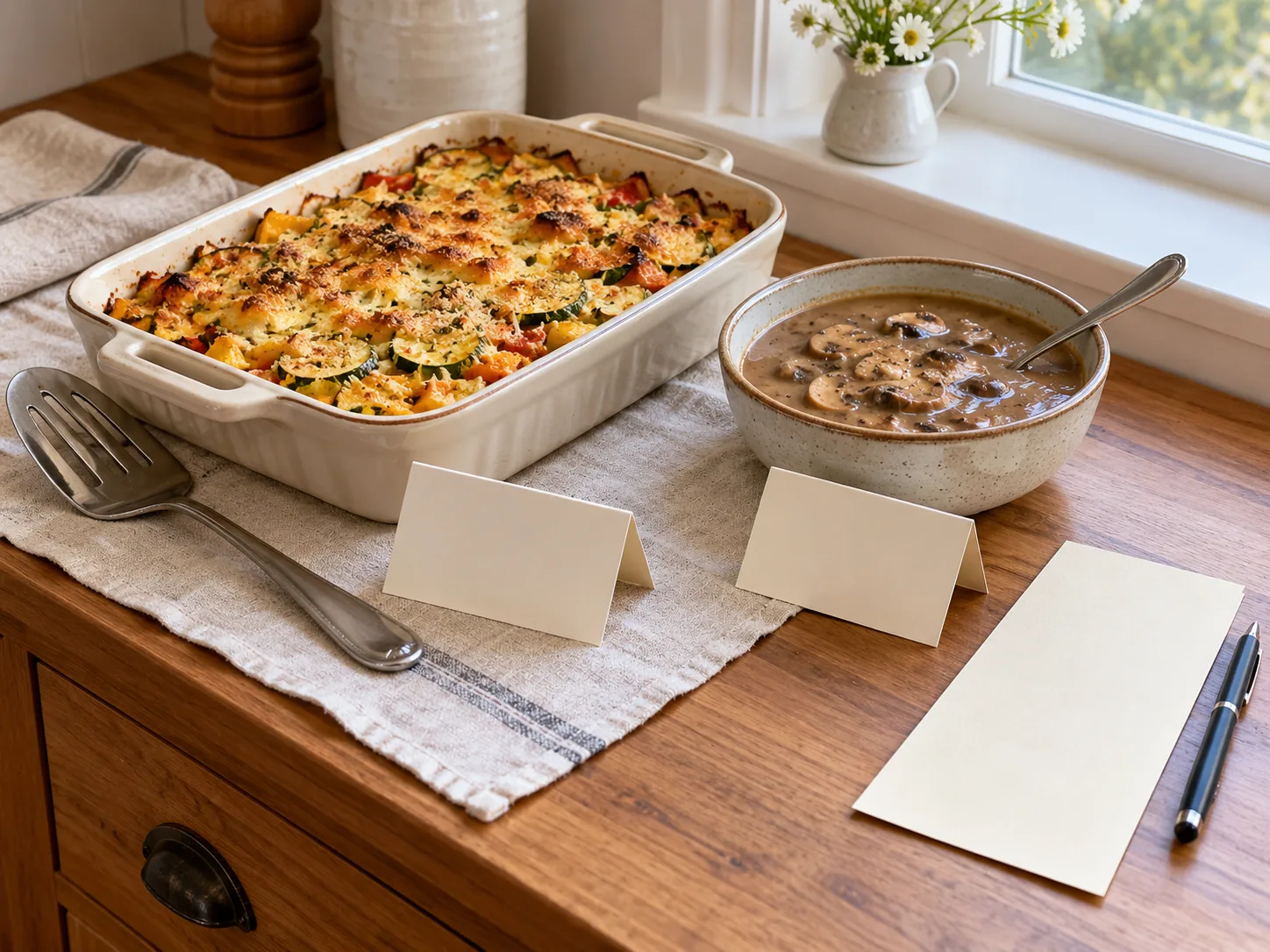
A casserole can arrive with a browned top and very little information. A useful buffet label gives it a name, lists what went into it and tells guests whom to ask. Put that information beside the serving dish, with the original ingredient packaging available nearby.
Start the conversation about allergies and dietary needs before the meal. A card can describe a dish; it cannot certify that the food is free from allergens or that cross-contact has not happened. Keep those two jobs separate as you plan the table.
Ask for the ingredients when you assign the dish
When someone offers to bring stuffing, ask for the ingredient list along with the number of servings. Bread, stock, butter and any sausage belong on that list, as do the ingredients in the bread and stock. A recipe link is helpful, but it will not show a last-minute substitution.
Send one short request with the potluck invitation: “Please bring the full ingredient information for your dish, including packaged ingredients, sauces and toppings. Let me know if anything changes.” Add this request when each person chooses a dish.
Ask guests privately what they need to avoid and what preparation arrangements work for them. You do not need to put anyone's name or medical information on a buffet card. The label belongs to the food; the conversation belongs with the guest.
We may earn a commission from purchases through these links. Amazon search links open comparison results; check the selected item’s suitability.
Use a separate sheet of printer paper for the complete ingredients when a small buffet card cannot hold them. Keep the dish number identical on both.
Use a short card and a complete ingredient sheet
A small folded card is good for the dish name and the most useful immediate information. A full ingredient sheet gives you room for the details. Number both so a guest looking at “03 — Mushroom stuffing” can find the matching list without opening several phone messages.
| Field | What to write |
|---|---|
| Dish name and number | A plain description, such as “03 — Mushroom stuffing.” |
| Full ingredients | Every ingredient, including cooking fats, sauces, stock, seasonings and garnishes. Use the matching sheet when the card is too small. |
| Packaged ingredients | Product names and their complete ingredient information; keep the original labels available. |
| Allergens present as ingredients | The specific relevant foods identified from the actual ingredients and packaging. This is a summary, not a substitute for the full list. |
| Dietary description | A description you have checked against the ingredients, or leave it unclaimed while you find out. |
| Preparation information | Relevant shared equipment or handling information that the cook can confirm. Do not guess. |
| Person to ask | The cook or host who has the ingredient information. |
Write the food name in the largest type. Use dark text on a light background and keep decorative leaves away from the ingredient text. A guest should not have to recognize a tiny color-coded symbol to find out whether a dish contains milk.
We may earn a commission from purchases through these links. Amazon search links open comparison results; check the selected item’s suitability.
Fold cardstock into cards large enough for the dish name and its matching ingredient-sheet number. A crowded tiny card is harder to use at a busy buffet.
Write the name and reference number in dark, large lettering with washable markers. Keep the ink on the separate card and away from food-contact surfaces.
Copy this blank buffet label
| Dish name and number | ________________________________________ |
|---|---|
| Ingredients or matching ingredient sheet | ________________________________________ |
| Allergens present as ingredients | ________________________________________ |
| Dietary description, if confirmed | ________________________________________ |
| Preparation information or questions | ________________________________________ |
| Person to ask | ________________________________________ |
Open the printable blank buffet labels. Fill in the cards in your browser and print them, or print blank cards to write on. Keep a separate sheet for any ingredient list that will not fit; do not shrink the text until it becomes difficult to read.
The blank spaces are deliberate. An empty allergen field does not mean “none,” and a missing answer should be marked “information not confirmed” until the cook provides it.
Read the actual packages
The FDA identifies nine major food allergens in the United States: milk, egg, fish, crustacean shellfish, tree nuts, peanuts, wheat, soybeans and sesame. Guests can be allergic to other foods too, so a checklist of nine does not replace the full ingredient list.
Read every package each time. The FDA explains that a product may identify an allergen within its ingredient list without a separate “contains” statement, and that “may contain” warnings are voluntary. Preserve those warnings rather than translating their absence into an assurance. See the FDA's guide to reading food labels.
For a compound ingredient such as stock, put the brand and product beside its ingredient information. “Vegetable stock” alone leaves the guest guessing about everything else in the carton. Save the package or a clear photo of the complete label rather than relying on a remembered version.
Be specific about vegetarian dishes
“Vegetarian” can help someone choose dinner, provided the ingredients support it. For mushroom gravy, establish which stock was used. For a cheese-topped dish, choose cheese confirmed suitable for vegetarians; the Vegetarian Society explains why some cheeses use animal rennet.
A card reading “vegetarian; contains milk” can communicate both facts. A vegetarian description alone says nothing about milk, egg, wheat or other allergens. Likewise, removing a breadcrumb garnish from a finished dish does not establish that it is suitable for someone who must avoid wheat or gluten.
If a cook cannot confirm a stock, sauce or cheese, write down what is known and ask before adding a dietary claim. “Mushroom gravy — stock information pending” is more useful than a confident label based on its brown color and lack of visible meat.
Give every dish its own utensil
FARE explains that cross-contact happens when allergen proteins transfer between foods; cooking does not reliably solve that problem. A spoon moved from macaroni and cheese to a vegetable dish can change what is on the guest's plate without changing either card.
Arrange the serving utensils with their own dishes and keep spare clean ones nearby. Discuss a separately prepared, protected portion with a guest who needs it instead of assuming a shared buffet is suitable. Preparation surfaces and equipment need appropriate cleaning, not just a quick wipe. FARE's cross-contact guidance explains the distinction.
Give one kitchen helper the job of matching the cards, ingredient sheets and serving spoons before dinner. The holiday prep-station guide has other small jobs that keep everyone out of the same corner of the kitchen.
Place buffet label holders beside the corresponding serving dish and check that each card is stable and readable. Move the card when the dish moves.
Keep the label with the food
If a serving dish moves, move its card too. If a fresh tray comes out with a changed ingredient, give it its own corrected information. Keep separate toppings labeled separately, including nuts, grated cheese and dressings.
At the end of the meal, carry the ingredient information over to the leftover packing station. A container of stuffing needs its own identity once it leaves the buffet. The guest should be able to open tomorrow's lunch and know which dish came home.
Put the information where a guest can read it
Make the card readable from the normal serving position rather than hiding it behind a hot dish. Keep the complete ingredient sheet in a dry place nearby and name the person who can answer a question. A decorative card is useful only if the guest can connect it with the actual food.
When space is tight, a clear dish number and a matching numbered ingredient sheet are better than shrinking a long ingredient list to tiny print. Use plain words for the food and keep the dietary description separate from any allergen information.
Correct a changed dish openly
If a contributor substituted an ingredient, update the information before the dish reaches the buffet. Do not leave the old card in place because the difference seems small. A different stock, spread, chocolate or sauce can matter to a guest even when the finished dish looks the same.
Keep toppings in their own labeled bowls with separate utensils. If a serving utensil is moved or a food’s history becomes uncertain, tell the guest rather than relying on a dietary label to answer the new question. Honest limits and complete ingredient information are more useful than a broad reassurance the host cannot verify.