A good kitchen gift has somewhere to go and something to do. The friend who bakes every weekend may welcome a scale; the person who brings the potatoes to every gathering may get more use from a casserole carrier. Start with a meal they already make, then look for the missing tool or the worn-out one they keep putting back in the drawer.
I prefer useful individual pieces to a large set chosen mainly because it looks generous. Seven tools that duplicate what someone owns are seven things to store. One well-chosen peeler can belong in tomorrow's dinner.
This article contains affiliate links. As an Amazon Associate, Fondfolk earns from qualifying purchases.
Choose the size of the gift before the product
For a small present, start with one preparation tool or a familiar pantry ingredient. A peeler, a turner or the salt someone already likes can be the whole gift. If you want to add something personal, write down a dish you think they would enjoy making with it; there is no need to turn a useful utensil into a basket of unrelated extras.
For a larger budget, choose one tool the cook has actually asked for. A scale or thermometer is a good candidate when it fills a gap. For a shared gift, agree on the exact model before people contribute, particularly with cookware that must fit an oven or work with a particular stove.
Set your total budget before comparing listings, and include delivery costs. Prices change, so these suggestions are grouped by the cook's habits rather than fixed price bands. A gift receipt is helpful even when you know the person well: their favorite version may have a different handle, shape or storage requirement.
For the vegetable cook: a peeler that earns its drawer space
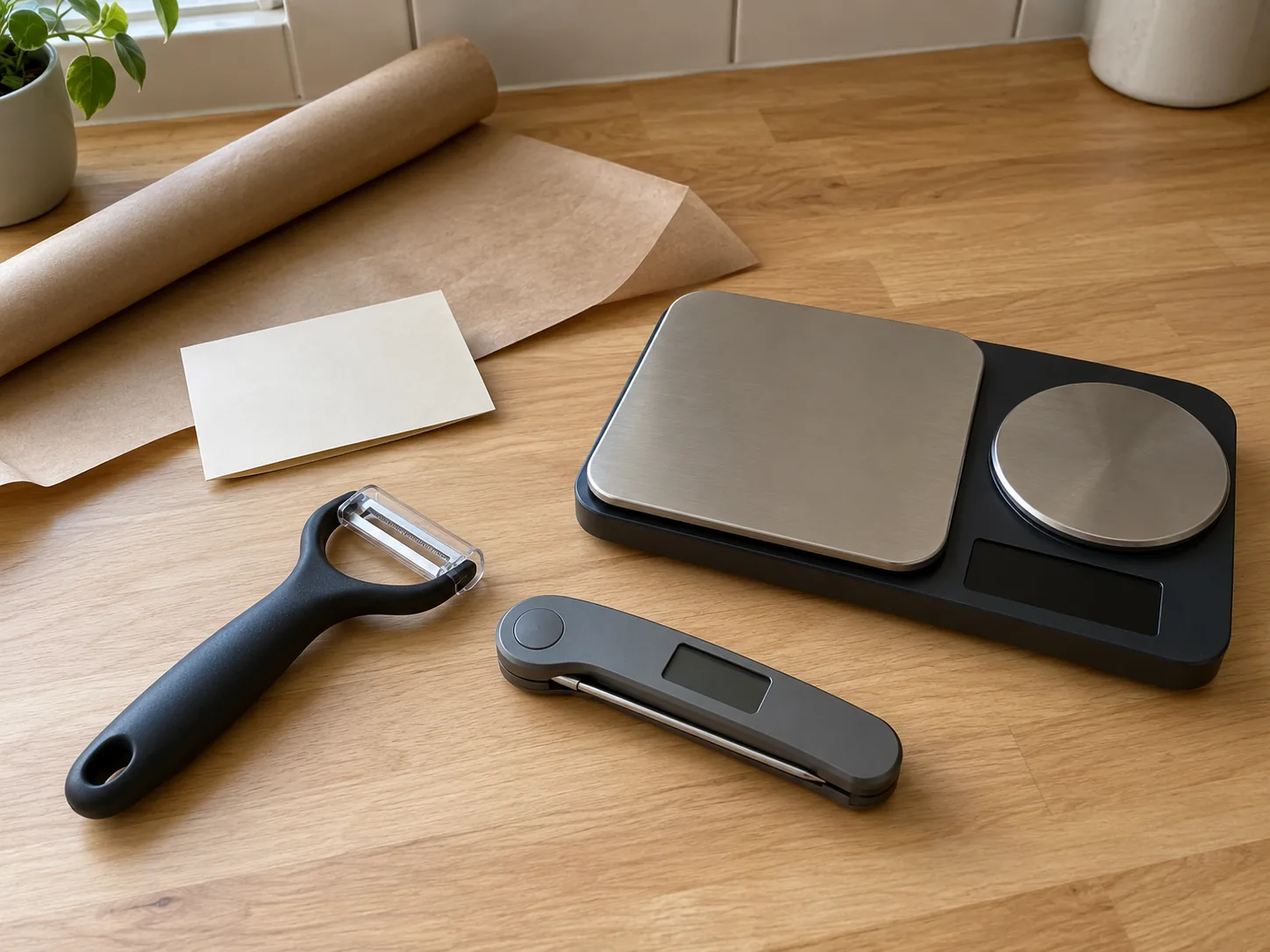
I recommend the OXO Good Grips Y-Peeler for someone who regularly peels potatoes, carrots or apples and needs a replacement. Its broad Y-shaped head offers a different grip from a straight swivel peeler, so it is worth knowing which shape the recipient prefers.
OXO lists this model at roughly 6 by 3 by 1 inches. That makes the drawer question fairly easy to answer, though a crowded utensil divider can still be a poor fit. It also has a hanging hole if that is how the kitchen is arranged.
Keep the blade protected in its packaging when you wrap it. A few apples and a note pointing to which apples work for baking, sauce and snacking make a thoughtful pairing if fresh food suits the occasion. Leave out the produce if the present will sit under a tree for weeks.
For the baker who also mixes spices: a dual-platform scale
I prefer the KitchenAid KQ909 dual-platform scale when someone wants to weigh both larger ingredients and smaller spice quantities. The two platforms are the reason to choose this model; a cook who only needs to weigh a bowl of flour may be perfectly happy with a simpler scale they already own.
Before giving any scale, find out whether the recipient's recipes use weights. Someone who follows gram-based bread recipes has an immediate use for it. Someone who mostly cooks by taste may care more about easy storage and a clear display than extra measuring features.
Small increments on a display should not be confused with a guarantee that every tiny amount is measured accurately. Follow the particular scale's instructions and limits, and use the spoon measurement when that is what a recipe specifies. Choose a scale when the recipient’s recipes use weights.
For the roast cook: an instant-read thermometer
The Lavatools Javelin PRO Classic is the thermometer I recommend from this collection. Its folding probe and rotating display suit quick checks where the angle of the food can make a fixed display awkward to read.
This is a useful gift for someone cooking chicken, turkey, meatloaf or reheated casseroles who does not already have a suitable thermometer. It belongs beside the stove while the food cooks, ready for a check; it is not a probe to leave inside a running oven.
Give it with a link to placing a meat thermometer correctly. Finding the right spot matters as much as owning the tool. A timer tells the cook when to look at dinner; the thermometer helps answer a different question about the temperature inside it.
For the pancake-and-egg cook: a silicone turner
A turner makes a particularly sensible gift when you know the recipient uses coated cookware. I recommend the GIR Ultimate Turner for lifting food without bringing a metal edge into contact with the coating.
Look at the size before buying. GIR lists this turner at 13.4 inches long with a 3.3-inch-wide head. Someone using a small egg pan may prefer a smaller utensil; someone turning a pancake needs enough support under the food. “Silicone” alone does not answer that question.
The manufacturer's current heat limit for this model is 425°F. It is a cooking utensil, not something to leave resting on a burner or inside the oven. Our guide to cooking vegetables without steaming the whole pan explains how pan space and heat work together, including the care a coated surface needs.
For the small-batch baker: a sheet that fits the oven
I prefer ceramic-coated bakeware when the cook wants that surface and is happy to care for it. The Caraway 15-by-10-inch baking sheet is a useful choice for someone who makes smaller batches and has measured their oven space.
Caraway describes its ceramic coating as made without PFAS, including PTFE and PFOA. That is a specific manufacturer materials statement, not a promise that every cooking practice is safe. The sheet still needs the right utensils, temperature and cleaning method.
This is a coated metal sheet, and its size matters. It cannot always take the same amount of vegetables or cookie dough as a larger half-sheet pan while leaving enough space between pieces. For a cook who usually roasts dinner for six, a medium sheet may add batches instead of making dinner easier.
Caraway advises against heating the sheet empty or putting it under a broiler. Use wood or silicone utensils and let it cool before handwashing. The sheet-pan guide covers the questions to settle before choosing a replacement.
For the person who brings dinner: an insulated carrier
The person arriving with a casserole has already done a generous job. I recommend the OXO insulated casserole carrier when they need a way to carry a dish and the fit has been confirmed.
OXO says it fits most 9-by-13-inch bakeware. “Most” matters: the dish's handles and lid may extend well beyond its cooking area. Ask for the full outside measurements, including the lid, and confirm the carrier's usable clearance before buying. Do not assume that two products labeled 9 by 13 inches are a matched pair.
Insulation also does not establish how long a meal stays at a safe temperature. Agree on a temperature-control plan with the person carrying the food. Give the carrier to solve the carrying problem, with enough room for the dish the person actually uses.
For the cook who has enough tools: their preferred salt
A familiar ingredient can be a better gift than another object. I recommend Diamond Crystal kosher salt when it is the brand the recipient wants to cook with. Its coarse flakes suit cooks who like that texture for seasoning.
Salt is also a good example of why an ingredient gift should come with its label intact. Different salts occupy different amounts of space for the same weight. A teaspoon of these flakes is not an automatic replacement for a teaspoon of fine salt in a recipe.
If the cook is interested in brining, add the dry-brine and wet-brine comparison. Keep the manufacturer's package rather than pouring the salt into an unmarked decorative jar. The exact brand is useful information, especially when a recipe names it.
Make the final choice personal
Before ordering, answer three questions: does this person already have it, will it fit where they cook, and will they enjoy caring for it? A handwashed baking sheet may suit one cook and frustrate another. A scale is welcome when weighing is part of their cooking, and a carrier needs a real dish to carry.
Then stop at the useful gift. A short note saying why you chose it is enough: “For the apple cakes you keep making,” or “For getting your potatoes to the table.” The present already has a place in their kitchen.
Ask a question that reveals the useful gift
Instead of asking which kitchen gadget someone wants, ask what part of a meal is awkward for them. Perhaps their scale is difficult to read under a large bowl, their turner will not fit the pan or their casserole carrier cannot close over the lid. Those answers give you dimensions and functions to check. They also tell you when a gift is unnecessary because the cook already has a method they like.
If the answer is a specific replacement, photograph or write down the current model and what needs to improve. A different handle or coating can change the experience even when the product category is the same. Include a gift receipt where possible, and keep the original care information with the item.
Make the accompanying note practical
A useful note might name the recipe the tool suits and where its instructions can be found. For a thermometer, that means its cleaning and use directions; for bakeware, the heat and care limits. Avoid presenting the gift as a fix for someone’s cooking or as evidence that they should host more often.
Food gifts need the same attention to the recipient’s preferences. Keep the product label intact and ask before choosing an unfamiliar spice blend or ingredient. The best finishing touch is often fewer extras: one wanted tool, the information needed to use it and room for the person to choose its first job.